
The final report meeting for the “FY4 Supplementary Budget Use Case Demonstration Project Toward the Realization of Trusted Web”, conducted as part of the Trusted Web Promotion Council, is currently being held. It is being held on 2/29 and 3/4.
Event Overview
| Date and Time | February 29, Reiwa 6 (Thursday), 9:55–17:00 (break from 12:00–13:00) March 4, Reiwa 6 (Monday), 10:00–17:05 (break from 12:00–13:00) *Times are subject to slight change. |
|---|---|
| Format | Online (Zoom) |
| How to Apply | Please apply using the links below. If you will attend both days, please apply for both. Apply to participate on February 29 (Thursday) here Apply to participate on March 4 (Monday) here |
I am participating in this demonstration as an expert responsible for the following use case.
February 29 (Thursday)
| Time | Type | Item |
| February 29 10:00–11:00 | Report | Dentsu International Information Services, Inc. (A New Mechanism to Promote Trusted Transactions Based on KYC/KYB) |
This initiative is a demonstration project that examines and verifies a new mechanism for promoting trusted transactions based on KYC/KYB, using “opening a corporate bank account at a financial institution” as an example. It is based on the prospect that future use of Trusted Web technology will make it possible to verify trust in information across entities, and that if issuers of certificates concerning KYC1/KYB2 can provide verifiable certificates (VCs: Verifiable Credentials), KYC/KYB data could be reused to improve efficiency and potentially promote trusted transactions.
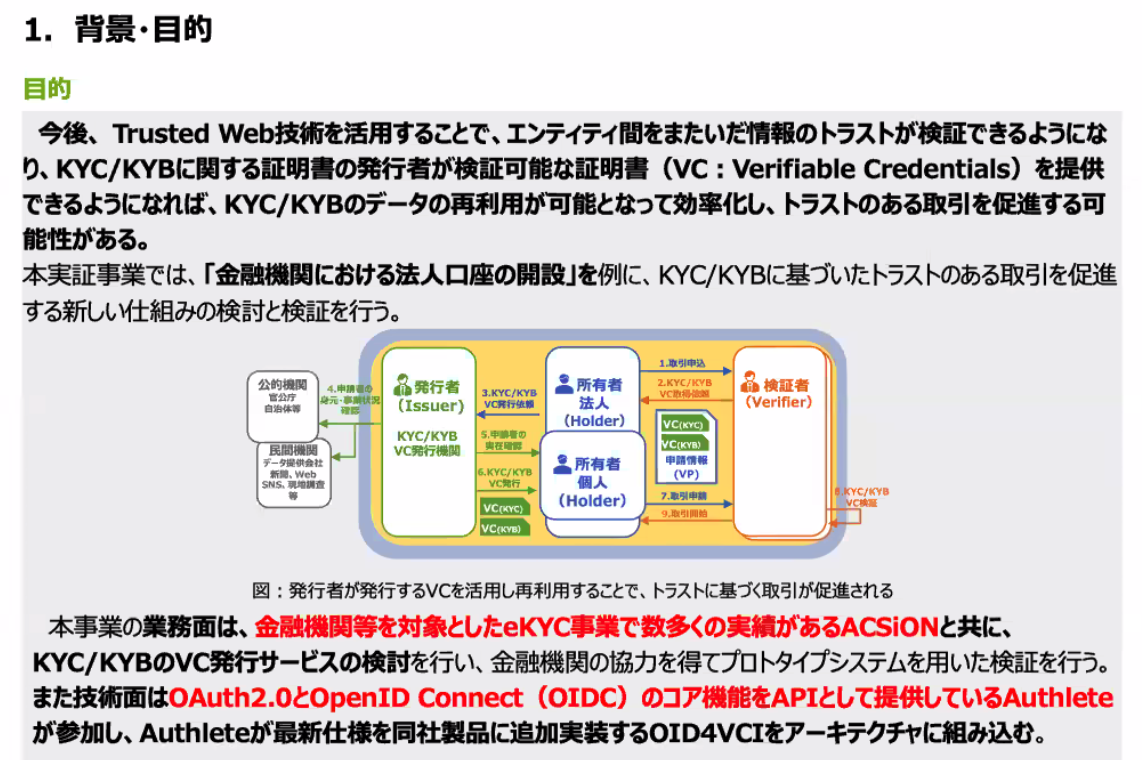
In the demonstration, Dentsu Soken worked with ACSiON, which has extensive experience in eKYC projects for financial institutions and others, to examine a KYC/KYB VC issuance service and conduct verification using a prototype system with the cooperation of financial institutions. On the technical side, Authlete, which provides the core functions of OAuth2.0 and OpenID Connect (OIDC) as APIs, participated. The architecture incorporates OID4VCI (OpenID four Verifiable Credential Issuance), adding implementation of the latest specification to the company’s product.
My principal comments were as follows.
- 【Legal implications】It was found that KYC/KYB information can in practice be provided as VC/VP3 with sufficient reliability and technical feasibility, but legislation such as the Act on Prevention of Transfer of Criminal Proceeds may not permit this. Legal reform should also be considered, and it is very good that the demonstration yielded insights on this point.
- 【Technical implications】In the VC Issuer-Holder-Verifier model, making the Verifier anonymous to the Issuer is highly significant for privacy from the perspective of the Holder (the individual concerned). From the perspective of the VC Issuer, however, not knowing who will use the information or for what purpose is a major risk factor. One technically conceivable way to improve this situation would be to group Verifiers in similar lines of business that share the same purpose and impose an Audience Restriction on the group. For example, a VP request could be issued with a group signature, and the Issuer could issue a VC to that group.4 These points should be fed back to standards-development organizations.
I also asked various other questions, but the whole event should eventually be streamed on the Trusted Web YouTube channel, so please refer to it there. Once it is published, I will add a link to this article as well.
Footnotes
- Know Your Customer. Identity verification of individuals
- Know Your Business. Identity verification of corporations
- Verifiable Presentation
- This might also resolve the “arteries and veins / information flow and money flow” issue—the problem of payment for information—that the Trusted Web Promotion Council has long identified.
Related posts

OpenID Summit Tokyo 2026 “Special Edition” Closing Keynote
The tickets apparently sold out instantly, so I had not introduced this event here; however, tomorrow, August 26, I will appear at the OpenID Summit Tokyo…
On May 19, I Will Deliver a Keynote at EIC 2026 in Berlin, Titled “When Software Becomes Staff: Governance, Security & Safety for Agentic AI”
On the first day of EIC 2026, I will deliver the keynote “When Software Becomes Staff: Governance, Security & Safety for Agentic AI.”
I Will Appear on the Okinawa Open Days Panel “Current and Future OSS Initiatives in Economic Security”
It is already the day of the event—in fact, I am writing this now (12/4 9:45) at my desk while preparing for the panel—but I will…
You must be logged in to post a comment.