
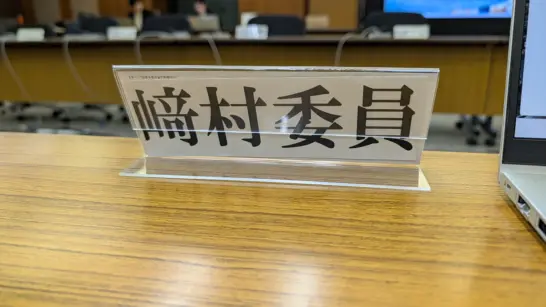
On September 30th, I retired from my position as a member of NHK's Central Program Review Committee, a role I had held for four years. (Although, in effect, my last meeting was the 739th Central Broadcasting Program Review Committee meeting on September 14th).
I am deeply grateful to all the committee members, NHK staff, and secretariat staff for their support over the past four years.
What is the Central Broadcasting Program Review Council?
The "Central Broadcasting Program Review Council" may not be very well known outside of NHK.
The Broadcast Program Review Council is a review body required by the Broadcast Act to be established by broadcasters in order to ensure the appropriateness of broadcast programs. In the case of NHK, Article 82 of the Broadcast Act stipulates that it shall have a "Central Broadcast Program Review Council" and "Regional Broadcast Program Review Councils" to handle domestic broadcasts, and an "International Broadcast Program Review Council" to handle international broadcasts. The Central Broadcast Program Review Council is composed of 15 or more members, and the members are appointed by the chairman with the consent of the NHK Board of Governors from among persons with academic expertise and experience.
Its role is to deliberate on program standards and basic plans for editing domestic broadcast programs in response to consultations from NHK, as well as to offer opinions to NHK regarding broadcast programs. Legally, NHK is required to respect the recommendations and opinions from the council and take necessary measures. It is not an organization that pre-approves individual programs or directs their production, but rather a mechanism to offer opinions on the nature of programs and broadcasting from various external perspectives, and to have those opinions reflected in program production. The NHK chairman also attends every meeting.
I joined this council in October 2022.
My usual work involves areas such as digital identity, privacy, and trust on the internet. As an extension of this, I've discussed issues like misinformation and filter bubbles in the Ministry of Internal Affairs and Communications' platform research group, and I've also considered the role of public media in the internet age.
From that position, I was given the opportunity to express my opinions on NHK's programs and projects, and these past four years have coincided with a period in which the broadcasting environment itself underwent significant changes.
One factor is the rapid development of generative AI.
ChatGPT was launched in November 2022, shortly after I became a committee member. In just a few years since then, the way people search for, understand, and use information has begun to change dramatically.
Another point is the mandatory implementation of NHK's internet service, which began in October 2025.
It's not just about "watching broadcast programs on the internet"; the places where people encounter information have expanded from broadcast receivers to search engines, social media, and AI. In this changing landscape, what role will public media play?
I have expressed my opinion on this issue numerous times at council meetings.
Not just "creating information," but also "preserving and being discoverable."
One of the things I repeatedly emphasized over the past four years was that I wanted NHK to pass on the programs and web content it has produced as a valuable information asset for the nation to future generations.
NHK possesses a vast collection of video footage, audio recordings, documents, and interview records that have been compiled over many years.
However, information cannot be used simply by being stored.
If we don't know "what exists," can't search for it, and can't access it when needed, then that information becomes practically nonexistent to society.
In that sense, I have long had high expectations for the role of NHK Chronicle.
On the other hand, currently, even information published in NHK Chronicle may not be found through NHK Chronicle's own search function. This is something that needs improvement.
However, there are also new possibilities here.
While manually organizing searchable metadata is a daunting task, recent AI technology is extremely powerful in its ability to analyze video and audio, structure the content, and make it searchable.
We will use AI not only to generate content, but also as a technology to rediscover and make available content that has been accumulated in the past.
I think this will be a very important topic for NHK.
The "gateway" to information is changing.
Another point I've repeatedly emphasized is the issue of access to information.
Television used to be the gateway to information. For example, I learned about the Aum Shinrikyo terrorist attacks and the 911/2 attacks through television (I remember watching the second plane crash in real time).
However, currently, some people learn about the news through social media, while others find it through Google searches. And in the future, we will see an increasing number of cases where people access information not through the search results themselves, but through AI-generated answers and summaries.
The important thing at this time is
"Is there any information on the NHK website?"
not only.
- Is that information searchable?
- Will they be linked?
- Can AI refer to this?
- And can users verify the information presented there by going back to the primary source?
Even as the entry points to information change, it remains a "reference point" to which people can ultimately return to reliable information.
I believe that this role will become even more important for public media.
Leaving links is also a public role.
When there was talk this spring that NHK would be closing some of its social media accounts, I expressed my opinion that they should keep as many accounts and posts as possible.
This isn't about wanting to save the social media itself.
What I mean is, please don't unnecessarily cut off access to information that is already shared and referenced within society.
The same applies to broken links.
When I searched for "Religion Hidden in Fantasy," which was discussed at the final council meeting, some of the links to the NHK page referenced by Google's "AI Summary," and some of the search results displayed directly below it, were broken. (This has now been fixed.)
I think this is a symbolic issue.
Information on the web isn't something that's "published and then forgotten."
It will be linked from other pages, registered with search engines, shared on social media, and eventually referenced by AI.
Information accumulates over time, forming the foundation for new information and knowledge.
With that in mind, the requirement to "remain accessible even after publication" should be incorporated into the system and content management design from the very beginning, rather than being a post-processing step.
So to speakPersistence by Design It's a way of thinking that could be called that.
Things I saw at the Kohaku Uta Gassen rehearsal
Among the activities of the council, I was particularly impressed by the opportunity to observe the rehearsals for the Kohaku Uta Gassen (Red and White Song Contest).
When I first visited, I was amazed by the scale and precision of the stage props.
For someone like me, who usually works in the digital world, it was incredibly refreshing to see how a massive stage set was reassembled in such a short time, and how a program was created through the combined efforts of people and physical mechanisms.
On the other hand, when I visited last year, LED panels were being used on a large scale, and I realized that the methods of stage production have changed considerably in just a few years.
When we talk about digitalization, we tend to focus only on software and networks, but the broadcasting industry involves many aspects of the "physical world," such as cameras, lighting, art direction, sound, stage production, and performers.
It was also an opportunity to realize once again that the program is made up of both of those elements working together.
What I learned from reviewing the TV program
And above all, the council meeting itself was a very interesting event.
Even when watching the same program, different committee members focus on completely different aspects.
- People who watch the performance.
- People who watch the performers' comments.
- A person who looks at the social context.
- People who view visual expressions.
- People who see connections to history and culture.
Because new perspectives that I had never considered before kept coming up one after another, I was often busy taking notes during the council meetings.
One of the things I've learned over the past four years is just how multifaceted the act of "viewing content" truly is.
What will we leave behind for the next generation?
NHK possesses a vast cultural asset that has been accumulated over a long period of time, encompassing not only news but also documentaries, educational programs, music, dramas, and regional programs.
As generative AI becomes widespread, the cost of generating information itself will decrease rapidly.
That's precisely why,
- Who conducted the interview?
- What was the process by which it was made?
- When was it made?
- What are the primary sources?
Therefore, the origin and reliability of information will become increasingly important.
- To create reliable information.
- To save it.
- Make it so that it can be found.
- To ensure that future technologies can also refer to it.
- And, if necessary, allow people to refer back to the original source to verify the information.
I believe that considering these elements as a unified whole will be crucial for public media going forward.
As I conclude my four-year term, I would like to take this opportunity to express my sincere gratitude once again to all the committee members, NHK staff, and secretariat staff.
I hope that reliable information and a rich culture will continue to be accumulated, utilized, and passed on to future generations.