
487
VIEWS
First, I think this is a very well-written draft report. I commend the secretariat and committee members. Within it, I pointed out only the following 2 points.
| (3) Trends in International Organizations | |
| (Relevant section) Following ② ITU-T | (Comment) Although ISO is mentioned briefly in the ITU-T section, In ISO/IEC JTC 1, a joint committee with IEC, ISO/IEC 24931-1 Information Technology – Metaverse is under development in SC 24. ISO/IEC 27573 Privacy protection of user avatar and system avatar interactions in the metaverse is also under development in SC 27. Some mention of these would be desirable. Other Metaverse-related standards are also under development. The following is a list. ISO/IEC TR 23090-27:2025 Information technology — Coded representation of immersive media — Part 27: Media and architectures for render-based systems and applications ISO/IEC TR 23844:2023 Information technology for learning, education, and training — Immersive content and technology ISO/IEC DIS 24931-1 Information Technology — Metaverse — Part 1: Concepts, definitions and terminology ISO/IEC CD TR 25468 Information technology — Learning, education, and training — Metaverse services for LET ISO/IEC AWI 27573 Privacy protection of user avatar and system avatar interactions in the metaverse ISO/IEC CD 23090-39 Information technology — Coded representation of immersive media — Part 39: Avatar representation format |
| (3) Principles for the Metaverse (2.0nd Edition) | |
| (Relevant section) Measures for confirming authenticity ●Where it is necessary to identify the person responsible for an actor within a space, users must be clearly informed through terms of use, community guidelines, or similar means of the information used to identify that person or that the metaverse-related service provider has identified the responsible person. | (Comment) The 3st bullet, “●Where identity verification of the person responsible for an actor within a space is required, it should be possible to determine that identity verification has been completed, including the verification method,” is important. OpenID for Identity Assurance, which has been adopted by the Digital Agency and others, could be used for this purpose. When used together with identity federation technologies and Verifiable Credentials, it becomes verifiable data and is even more effective. On the other hand, it is undesirable from a privacy perspective for information used for identity verification to be disseminated to many places. This is particularly true given that linking an avatar with a natural person may create substantial privacy risks. To address this, a “semi-anonymous authentication” system is desirable in which a pseudonym provider performs identity verification, provides the metaverse provider or community with a “pseudonym” or “anonymous authentication function” together with the metadata above, and discloses information when necessary to a Designated Opener such as an authority or disclosure requester (see ISO/IEC 29191). In light of these points, I propose revising the 1nd bullet as follows. ●Where it is necessary to identify the person responsible for an actor within a space, users must be clearly informed through terms of use, community guidelines, or similar means of the information used to identify the person responsible, or that the responsible person has been identified by a |
Related posts

OpenAI Launches Sign in with ChatGPT (Based on OpenID Connect)
(Work in progress; last updated 2026-10-02 12:39 JST) On September 29, at DevDay 2026, OpenAI officially announced Sign in with ChatGPT (SIWC). I would like to…
When Software Becomes Staff: Governance, Security, and Safety for Agentic AI
Below is the transcript of my keynote speech at EIC 2026 on May 19, 2026. The slides are provided as a PDF at the end of…
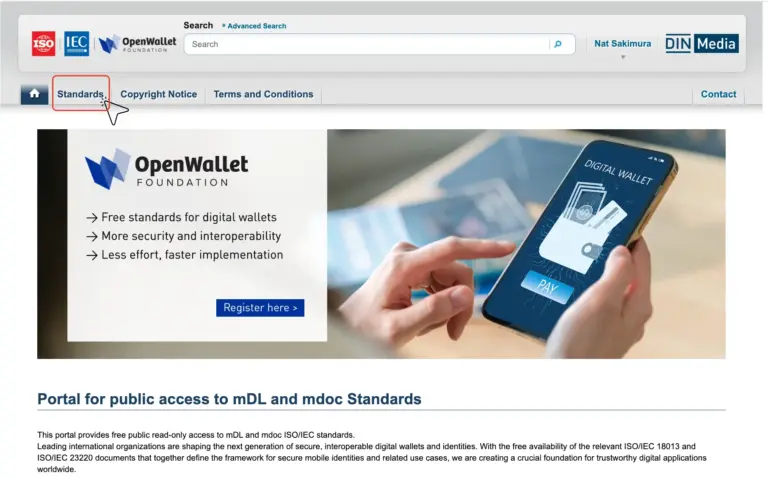
mDL/mdoc Standards Are Now Available to Access Free of Charge
As I shared in real time with those who follow me on X, standards related to mDL/mdoc are now available to access free of charge at…