

Update: Public comments are being accepted from August 4 through 27. If you have comments, please submit them via https://www.soumu.go.jp/menu_news/s-news/01iicp01_02000126.html. Submission forms and other information are available on this e-Gov page.
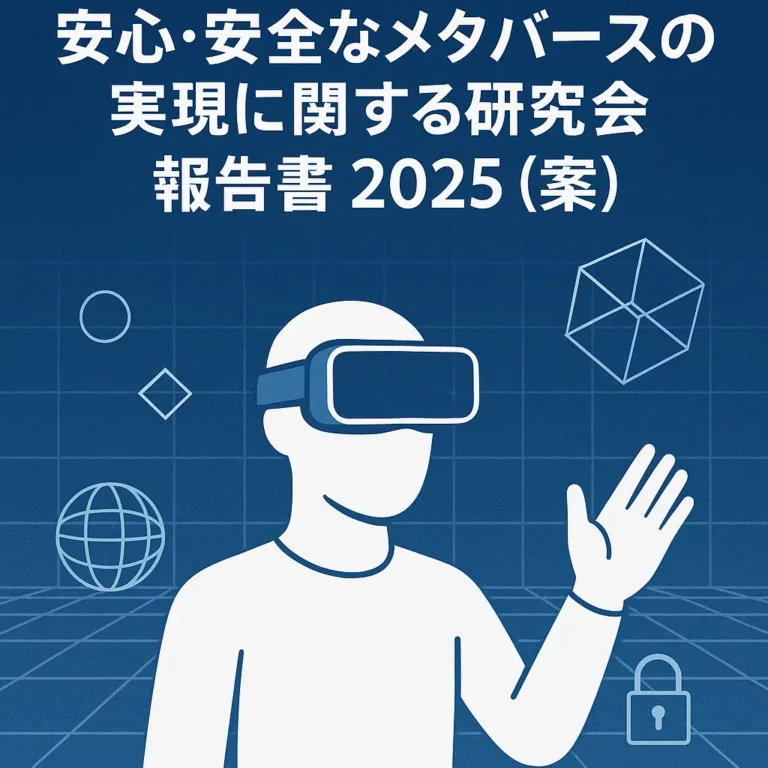
Today, July 23, Reiwa 7 (Wednesday), from 15:00 to 17:00, the Ministry of Internal Affairs and Communications Study Group on Realizing a Safe and Secure Metaverse (16th meeting) was held, and the Draft Report 2025 was released. The Nikkei had reported that it would be released yesterday, but…
I will have NotebookLM summarize the substance at the end of this article, but readers of this blog are probably most interested in identity verification. I also posted about it on X (formerly Twitter); these are the relevant points.
●Where identity verification is required for the person responsible for an actor operating in the space, it should be possible to determine that the person has been verified, including the method used.
●Consider introducing and strengthening necessary measures, including an identity verification system at registration.
「●空間内の行動主体について、その責任を負う者の本人確認が必要とされる場面においては、
本人確認済である旨がその確認手法も含め判別できるようにすること。」
「●登録時の本人確認システムを含む必要な措置の導入・強化に向けた検討を行うこと。」など
As I wrote in my book, Digital Identity, this concerns the concept of an Accountable Digital Being. At the same time, being told to verify my identity with a My Number Card separately for every metaverse operator feels unsettling (and raises risk because the information becomes dispersed). I would like the framework to incorporate something like the Pseudonym Provider considered in Germany around last year under eIDAS 2, or a partially anonymous authentication provider. That probably does not explain much by itself. In essence, a “partially anonymous” provider with robust security standards, including operational standards, would verify a person using a My Number Card or similar means and issue a pseudonymous Verifiable Credential/Digital Credential. The person would then use it to register with a metaverse or one of its worlds. Under a court warrant, investigators could approach the provider and trace the credential back to the individual. The requirements are set out in “ISO/IEC 29191 Information technology — Security techniques — Information security management systems — Requirements for partially anonymous, partially unlinkable authentication,” edited by Professor Sako of Waseda University, who is also Vice Chair of MyData Japan. (The draft report mentions ISO only once, in relation to ITU-T. Given that this is the Ministry of Internal Affairs and Communications, perhaps that cannot be helped…)
In my book, the principle of an Accountable Digital Being is as follows.
Principle 1. Accountable Digital Being Everyone should be able to establish and re-establish a digital being that can be held accountable for its actions. This aims for a “Partially Anonymous” state that permits pseudonymous or anonymous activity to protect freedom of speech and thought, while allowing a duly authorized body to lift anonymity when an incident occurs. This enables those who commit unlawful acts to be held accountable and, through society’s recognition of that accountability, encourages people to consider the social acceptability of their actions. Moreover, if this principle becomes widespread, those without such a digital being could be excluded from society, so anyone who wishes to do so must be able to establish or re-establish one at any time.
(Source) Natsuhiko Sakimura. 2021. Digital Identity. Nikkei BP
I hope the discussion moves in a positive direction.
Below is NotebookLM’s summary of the draft report.
Summary of the Draft Report
1. Introduction: Definition of the Metaverse and Expansion of the Study’s Scope
Following the Study Group on the Utilization of the Metaverse and Related Technologies toward the Web 3 Era, the Ministry of Internal Affairs and Communications has convened the Study Group on Realizing a Safe and Secure Metaverse since October 2023. Initially, discussion focused mainly on VR metaverses intended primarily for interpersonal communication and entertainment. Since December 2024, however, the scope has expanded to metaverses for diverse purposes, including AR and MR metaverses.
In this report, a “metaverse” is defined as a virtual space with the following 4 elements.
- “i. A sense of presence and fidelity appropriate to the purpose of use (this may involve reproducing physical space as in a digital twin, constructing a simplified model of physical space, constructing a different world with different physical laws, or virtually adding and integrating information into physical space itself)”
- “ii. A sense of self-projection and immersion”
- “iii. Interactivity (in many cases, in real time)”
- “iv. Anyone can participate in the virtual space (openness)”
Interoperability, persistence, and the ability to conduct economic activity comparable to that in physical space are also cited as elements found in many metaverses.
With a view to revising the “Metaverse Principles (Version 1.0),” this report surveys domestic and international trends from the 3 perspectives of markets, technology, and policy and institutions, and summarizes discussions on the social impact of interactions and convergence between physical and virtual spaces.
2. Market Trends Surrounding the Metaverse
Although the metaverse market is currently said to be in a “trough of disillusionment,” it is steadily developing as infrastructure for solving social challenges and is expected to become more widely adopted.
2.1. Changes and Forecasts in Market Size
- Global market size: In 2024 it stood at USD 74.4 billion, and by 2030 it is forecast to expand to USD 507.8 billion. E-commerce within the metaverse accounts for the largest share, followed by gaming and health and fitness.
- Domestic market size: According to Yano Research Institute Ltd., fiscal 2023 saw a year-on-year increase of 35.3%, bringing the estimate to ¥186.3 billion; in fiscal 2024, it is expected to grow to ¥275 billion.
- Ministry of Internal Affairs and Communications estimates:
- Consumer market: In 2025, it is estimated at approximately ¥80 billion; by 2030, it is projected to expand to approximately ¥410 billion. The tourism segment in particular is expected to expand by more than 6 times in both VR and AR/MR metaverses.
- Enterprise (business-use) market: In 2025, it is estimated at approximately ¥830 billion; by 2030, it is projected to expand to approximately 1 trillion ¥600 billion. Particularly high growth is forecast in civil engineering and construction sites, workplace training, and offices and workplaces.
- Total: In 2025, it is estimated at approximately ¥910 billion; by 2030, it is projected to expand to approximately ¥2 trillion. Although the enterprise market is larger, the consumer market is analyzed as having the higher growth rate.
2.2. Evolution of Devices
- VR devices: New ultra-high-resolution, ultra-lightweight models are being developed and are expected to provide a more comfortable experience.
- AR/MR devices: New glasses-type devices continue to appear, making everyday use increasingly convenient. High-performance AI-enabled glasses are also under development, drawing attention to new experiences in which AI recognizes and understands objects in the user’s field of view, displays information, and suggests actions.
2.3. Diversification of User Trends
- Traditional metaverse users have been thought to be mainly male and in their late 10s through their 20s, but users may become more diverse and younger in the future.
- Following the response to a popular livestreamer’s VRChat experience video, compared with 2023, VRChat’s popularity in Japan on Google Trends increased by roughly 5 times.
- Daily active users are increasing on gaming platforms such as Roblox, where just under 40% of users are aged 13 or younger. Growth of approximately 40% has been observed particularly in the Asia-Pacific region, including Japan.
2.4. Stakeholder Mapping and Challenges
Stakeholders surrounding the metaverse are organized into business and activity, spatial, platform, network, hardware, and foundational technology layers. Given the diversification of user attributes and roles, the need for entities that connect stakeholders has been noted.
3. Challenges and Responses Concerning Communities and Information Distribution in the Metaverse
Communities and information distribution unique to the metaverse have various characteristics, and the following 16 associated challenges have been identified.
Examples of major challenges:
- Diverse types and forms of content: Rights and responsibility for individual content are unclear.
- Sense of self-presence in a space: Self-projection and immersion through avatars and characters can intensify data leaks and security breaches.
- User behavior: Risk of illegal or improper acts caused by autonomous control through AI and algorithms.
- Expansion of service use: As the user base and application fields expand, it becomes difficult to share unwritten rules and ethical norms.
- Characteristics specific to AR/MR metaverses: Challenges in information and data distribution and risks of privacy violations arising from the addition of information to physical space.
Study group discussions and proposed responses:
- Distinguishing increasingly sophisticated AI avatars from human avatars: How should AI avatars be distinguished from avatars controlled by humans? Options under consideration include mechanisms that ensure authenticity through voluntary user action and approaches that impose some limits on AI behavior.
- Diversifying user attributes and sharing ethical norms: How should unwritten rules and ethical norms be shared? Metaverse-related service providers are expected to explain the nature and context of the worlds they provide and promote user understanding.
- Acquisition, analysis, and use of multimodal information and data: How should circulating data, including biometric information, be handled? Discussions address ensuring transparency for users, rigorously obtaining consent before data acquisition, and technical measures by device manufacturers.
- Responsibility in increasingly complex contracts and transactions: Responsibility must be clarified, including for disputes between UGC creators and users. Mechanisms to prevent disputes, reporting channels, and clear response policies are expected.
- Rights in increasingly complex content and activities: Preventing infringement of others’ rights during UGC creation and respecting privacy are challenges. Discussions include stating policies in terms of use and guidelines and limiting data acquisition through technical measures.
4. Market Trends in Content Creation and Distribution
Content distributed in the metaverse can be categorized as worlds, NPCs, avatars, avatar accessories, objects, effects, content in the narrow sense, gifts, events, and other types.
Current state and challenges of the creator economy:
- The transaction value of BOOTH’s 3D model category has grown rapidly, indicating rapid growth in Japan’s metaverse creator economy.
- As users with backgrounds different from the so-called “old guard” enter the metaverse, the tacit understandings formed there may cease to function, making disputes more likely to surface.
- It is difficult to prove that creators qualify as businesses, and there are competing concerns between protecting creator anonymity and protecting consumers.
- The use of intermediaries is envisaged as a solution, but it is difficult to apply to creators who are not popular. The possibility of platforms acting as sales agents is also being discussed.
5. Considerations for Introducing Metaverses to Help Solve Social Challenges
The spread of the novel coronavirus prompted companies and local governments to adopt metaverses, increasing the number of use cases that help solve social challenges.
JR West’s “Virtual Station” business case:
- As the transportation business was affected by the pandemic, the company launched the Virtual Station business as a new revenue pillar and has continued it since its first opening in August 2022.
- By organically linking physical and virtual “stations,” the initiative contributes to regional revitalization and a society in which everyone can thrive.
- Considerations for business continuity:
- Follow a business-creation method authorized within the company: Propose the business from a perspective aligned with management challenges and make it easy for management to understand.
- Thoroughly verify and pursue the business’s fit with the company: Demonstrate how the company’s assets and capabilities can be leveraged and pursue uniqueness that only the company can deliver.
- Collaborate with an existing metaverse platform operator: Reduce investment risk and use the existing user base, eliminating the need to attract users from scratch.
Use of the metaverse at Expo Osaka-Kansai:
- At Expo Osaka-Kansai, held in 2025 under the theme “Designing Future Society for Our Lives,” many XR exhibits combine metaverses with advanced technology.
- The Ministry of Internal Affairs and Communications’ “Beyond 5G Ready Showcase” offers an experience remotely operating a lunar robot with VR goggles.
- The “Virtual Expo — Yumeshima in the Sky” provides opportunities to tour pavilions beyond the constraints of time and place.
- The Future of Life pavilion, produced by Osaka University Professor Hiroshi Ishiguro, presents a future living space in which humans and android robots coexist, drawing attention to changing relationships between humans and avatars.
6. Technology Trends Surrounding the Metaverse
Metaverse use requires advanced technologies, with particular attention focused on trends in haptics (technology that artificially generates force and tactile sensations) and AI.
6.1. Trends in the Use of Haptics
- Current state: Haptics is used in specialized fields such as gaming, professional training, and medicine, but use cases remain limited because dedicated devices are required, the types, modes, and body locations of sensations are limited, and reproduction accuracy is insufficient.
- Effects and benefits: Greater presence and immersion, and reproduction and sharing of sensations associated with movements and actions.
- Challenges:
- VR sickness: Motion-sickness-like symptoms caused by inconsistencies between sensory modalities, particularly vision and somatic sensation. Causes include human cognitive mechanisms, differences in the precision of visual and somatic sensory information, discrepancies in display timing, and intense content movement.
- Insufficient precision and accuracy in sensory reproduction: Full-scale use in professional training and similar settings requires stimuli equivalent to reality in strength, precision, mode, and quality.
- Response policy: Clarify human cognitive mechanisms; develop multistakeholder measures to avoid and mitigate “VR sickness”; and research and develop high-definition, high-precision, general-purpose haptic devices.
6.2. Trends in the Use of AI
- Examples of use: Applications are wide-ranging, including automatic generation of worlds and avatars, personalization, support for multilingual communication, detection and prevention of user misconduct, interactive customer service, and advertising.
- Challenges:
- Intensified risk of personal-data leakage and infringement: AI analysis of multimodal data on users’ physiology, psychology, and behavior acquired through HMDs and haptic devices may increase the risk of leaks and infringement.
- Intensified risk of user manipulation: Feeding analyzed data back to users in environments with greater presence and immersion through haptics and AI may increase the risk of manipulation based on human or AI intent.
- Insufficient multistakeholder discussion of interoperability and governance: Diverse stakeholders need to discuss interoperability and governance for the use in metaverses of AI developed or tuned by third parties.
- Response policy:
- Survey and research appropriate handling of multimodal personal data.
- Conduct concrete, empirical studies of the effects of AI output on users in immersive environments.
- Establish a forum for multistakeholder discussion of interoperability and governance.
Dynabook Inc. case study on integrating AR/MR metaverses with AI:
- By wearing glasses-type AR/MR devices, users can receive AI assistance while viewing physical space, enabling transcription and translation of conversations, object recognition, document summarization, and more.
- For industrial applications, this can advance digital transformation, alleviate labor shortages, and improve skills. For general users, however, concerns include information reliability, AI addiction, inappropriate content, social acceptance, physical safety, and privacy involving data acquisition and surveillance.
- Members noted the risk that data acquisition through devices could affect not only users but also people nearby, as well as concerns about data monopolization by dominant platform operators. They also noted that “filter bubbles” and “echo chambers” in AR/MR metaverses could be brought into physical space.
6.3. Data Acquisition and Use
- Cluster case study:
- The metaverse platform Cluster acquires and uses “action event logs” (user behavior histories) and “3D spatial synchronization communication logs” (avatar positions, postures, voice-chat audio, item positions, and so forth), comprising 2 types of data.
- The acquired data is used to develop and improve services, detect and prevent nuisance behavior, and provide information to creators.
- Users’ ages (to protect minors) and heights (to properly track body movements) are also collected.
- LUIDA (large-scale VR experimental platform):
- An online experimental platform using Cluster. Researchers design experimental worlds, and users participate in and consent to experiments, provide data, and answer surveys.
- Guidelines for data use: Manage anonymized IDs, clearly state purposes of use and rigorously obtain consent, provide mechanisms for voluntary participation and withdrawal, and respond to requests for data deletion.
- Challenges: Potential conflict between specifically explaining purposes of use under the Act on the Protection of Personal Information and experimental objectives; privacy concerns about acquiring biometric information online; and allocation of platform-operator responsibility.
- Challenges of data acquisition by AR/MR devices: Information linked to physical space requires more meticulous handling. Concerns include high-density data acquisition, behavioral prediction and personalization using sensitive personal data, and manipulative and ethical issues arising from hyper-personalized advertising.
- Hardware constraints such as illuminating an LED lamp during recording are being considered, but the report also proposes building a shared social understanding that “physical space, too, is now subject to data acquisition.”
6.4. Effects of Metaverse Use on People’s Bodies, Emotions, Behavior, and Other Aspects
- Positive effects:
- Digital therapeutics for mental health: BiPSEE Inc. offers a VR-metaverse application for treating depression and communication support for children with traits of autism spectrum disorder (ASD). Its strengths include using immersive experiences to address attention functions and accessing mental and physical information (biometric data) through HMDs.
- In the United States, VR metaverses for rehabilitation and chronic pain relief have been approved as medical devices.
- Challenges:
- Insufficient awareness and understanding in clinical settings of the significance, safety, and risks of these treatments.
- Challenges involving communications environments (latency).
- Risk of addiction and escape from the real world.
- Handling of patients’ sensitive information as data flows become complex among diverse stakeholders, and allocation of responsibility.
7. Domestic and International Policies and Institutions Surrounding the Metaverse
Policies and institutional frameworks for the metaverse are being considered in Japan and abroad.
7.1. Trends in the Japanese Government
- Ministry of Internal Affairs and Communications:
- Symposium “Promoting Safe and Secure Use of the Metaverse”: Held in March 2025. Discussions covered initiatives to ensure user safety and security, key points for business adoption, and benefits of adoption. The importance of handling multimodal and sensitive data, including biometric information obtainable from XR devices, was emphasized.
- Preparation of the “Guide to Introducing the Metaverse to Solve Social Challenges”: For companies and local governments considering metaverse adoption, considerations are organized by phase based on interviews about successful cases.
- “Demonstration Project for Technologies Contributing to an Environment in Which XR Devices Can Be Used Safely and Comfortably”: The National Institute of Information and Communications Technology and Kyoto University were selected to conduct a demonstration project examining desirable forms of use that minimize risks such as “VR sickness” and physical strain associated with XR-device use while maximizing benefits.
- Ministry of Economy, Trade and Industry:
- Japanese Industrial Standards Committee (JISC): Promotes consideration and implementation of an action plan for standardization in cooperative domains of the metaverse.
- “Strategic International Standardization Acceleration Project”: Plans to conduct “International Standardization of Avatar Configuration in Cyber-Physical Content Such as the Metaverse” and a “Survey of International Standardization Trends in Metaverse Terminology.”
- Japan Patent Office:
- Design System Subcommittee of the Intellectual Property Committee, Industrial Structure Council: Considering revisions to the design system based on actual business and design-creation practices in virtual spaces. A direction has been indicated toward protecting images depicting the shapes and other characteristics of virtual articles.
- Cabinet Office:
- Cross-ministerial Strategic Innovation Promotion Program (SIP), “Development of Foundational Technologies and Rules for Expanding the Virtual Economy”: Promotes technology development, standardization and rulemaking, use-case demonstrations, human-resource development, and other efforts to return value from cyberspace to physical space. It also includes measures for ELSI (ethical, legal, and social issues) and the cultivation of social acceptance.
- Establishment of the “Metaconsortium for Promoting Interverse Social Implementation”: Promotes industry-academia-government exchanges of views, research and development, and use of results, with the goal of developing the interverse industry and leading the global market.
7.2. Trends in Other Countries and Regions
- United States:
- No metaverse-specific legislation has been identified, but there are surveys and legislative developments concerning immersive technology.
- Government Accountability Office (GAO): Surveyed the use of immersive technology by federal agencies and identified challenges including cybersecurity and privacy compliance and high operating costs.
- “United States Leadership in Immersive Technology Act”: A bill intended to establish a national strategy for XR technology was introduced.
- NIST (National Institute of Standards and Technology): Conducted a current-state survey of cybersecurity and privacy standards for immersive technology. Existing risk-management guidelines and tools are expected to be used.
- EU:
- European Commission “An EU Initiative on Web 4.0 and Virtual Worlds: A Head Start in the Next Technological Transition”: From the 4 perspectives of people and skills, business, government, and governance, it presents 10 actions.
- European Commission Directorate-General for Competition: Published a policy brief on competition in generative AI and virtual worlds, indicating an approach of using antitrust law and the DMA to ensure market fairness.
- “Global Multistakeholder High Level Conference on Governance of Web 4.0 and Virtual Worlds”: Prompted discussion of global governance principles. Japan’s “Metaverse Principles” also received international recognition.
- “Virtual Worlds Toolbox”: Provides online resources to help EU citizens use virtual worlds appropriately.
- France: Measures include developing a national strategy; publishing “Building Respect and Diversity in the Metaverse,” a report intended to prevent hate speech and cyberviolence; establishing a standardization committee to promote metaverse interoperability; and soliciting immersive cultural and technology projects under the national “France 2030” investment plan.
- United Kingdom: The Online Safety Act is considered applicable to the metaverse, and the Digital Regulation Cooperation Forum (DRCF) is working to address challenges posed by the metaverse.
- Australia: The “Online Safety Act 2021” is considered applicable to the metaverse. The eSafety Commissioner has published a position paper on immersive technology and guidance on children’s use of immersive technology. Draft standards intended particularly to ensure children’s safety have been released and issued.
- China: The Ministry of Industry and Information Technology announced a 3-year action plan for innovative development of the metaverse industry (2023–2025). Shanghai and Beijing are also pursuing their own action plans and projects.
- South Korea: Enacted the Virtual Convergence Industry Promotion Act, the world’s first metaverse industry promotion law, and brought it into force in 8 of the same year. A Metaverse Self-Regulation Committee was also established and is developing guidelines for transactions, intellectual property, user protection, and other matters.
7.3. Trends in International Organizations
- MSF (Metaverse Standards Forum): Supports the development of standards for metaverse interoperability. Japan’s VRM Consortium was selected to co-chair a working group, and cooperation toward international standardization of VRM is advancing.
- ITU-T (International Telecommunication Union Telecommunication Standardization Sector): Established the Focus Group on Metaverse (FG-MV) and adopted 52 deliverables. Discussion of metaverse standardization is continuing.
- OECD (Organisation for Economic Co-operation and Development): Established a focus group on immersive technologies under GFTech (Global Forum on Technology). Japan’s “Metaverse Principles” were also mentioned in a report, which organized values that should underpin the development and use of human-centered immersive technologies grounded in democratic values.
- IGF (Internet Governance Forum): Workshops and sessions were held on children’s rights and safety in the metaverse and on governance of Web 4.0 and virtual worlds.
- WEF (World Economic Forum): Announced a new initiative, “Defining and Building the Metaverse,” focused on governance and creating economic and social value. It also published a “Responsible Metaverse Maturity Model,” providing a framework for assessing responsible operation of metaverse platforms.
7.4. Overseas Soft Law Concerning the Metaverse
- South Korea’s “Metaverse Ethical Principles”: Published by the Ministry of Science and ICT in November 2022. These nonbinding self-regulatory norms set out 3 aspirational values—sincere identity, safe experience, and sustainable prosperity—and 8 practical principles: authenticity, autonomy, reciprocity, respect for privacy, fairness, protection of personal information, inclusiveness, and responsibility for the future.
- EU “European Citizens’ Principles”: Based on recommendations from the European Citizens’ Panel, the “8 Values and Principles for Fair and Desirable Virtual Worlds” were developed. The 8 items are freedom of choice, sustainability, human-centeredness, health, education and literacy, safety and security, transparency, and inclusiveness.
- UAE “9 Self-Regulatory Principles”: Proposed in the “Responsible Metaverse Self-Governance Framework” white paper. The 9 principles are interoperability for access, privacy by design and by default, sustainability by design, reciprocity, transparency for trust, fairness, equity and inclusivity, commitment to diversity, accountability, and safety by design and beneficence.
- Deutsche Telekom’s “Ethical Guidelines for the Metaverse”: Across the 3 categories of protection, security, and responsibility, it sets out 9 guidelines to support a human-centered metaverse.
- Meta’s “4 Fundamental Values”: Identifies 4 key areas of concern in building the metaverse responsibly: economic opportunity, privacy, safety and integrity, and equity and inclusion.
- GatherVerse’s “8 Standards of the Metaverse”: Defines 8 core principles: humanity first, accessibility, education, equality, community development, safety and privacy, wellness, and ethics.
- RMA’s “Ethical Metaverse Principles”: Proposes an ethical foundation consisting of 11 items for realizing a safe and responsible metaverse.
8. Consideration of Japan’s “Metaverse Principles (Version 2.0)”
In October 2024, the Ministry of Internal Affairs and Communications published the “Metaverse Principles (Version 1.0).” In light of market expansion, increasing user numbers, service diversification, and the extension of discussion to AR/MR metaverses, this report makes a major update as the “Metaverse Principles (Version 2.0).”
8.1. Perspectives for Revising the Principles
- Changes since Version 1.0 was formulated
- Expansion of discussion from VR metaverses to AR/MR metaverses
- Expansion of discussion from communication and entertainment purposes to multiple purposes
- Advances in devices
- Comparison with soft law outside Japan
8.2. Structure of the Principles and Major Changes
The “Metaverse Principles (Version 2.0)” aim to realize democratic values and consist of 2 pillars: the “Principles for the Voluntary and Autonomous Development of the Metaverse” and the “Principles for Enhancing Trust in the Metaverse.” Although the principles primarily apply to metaverse-related service providers, all stakeholders are expected to refer to them, including users, people who create or provide content (including creators), people involved in rulemaking, people involved in improving user literacy, and device providers.
Major changes (underlined portions are additions and revisions):
- Preamble: A passage was added stating, “As physical and virtual spaces become more integrated than ever, events and values in the metaverse may affect not only virtual space but also physical space, potentially undermining democratic values in both.” This strengthens the discussion of impacts accompanying advances in AR/MR metaverses.
- Scope of the principles: “Device providers” were explicitly added to the intended audience.
Changes to the “Principles for the Voluntary and Autonomous Development of the Metaverse”:
- Openness and innovation:
- The commentary on “promoting innovation through free business development and creating a wide variety of use cases” adds that providers are expected to recognize that metaverse use may have both positive and negative effects on people’s bodies, emotions, behavior, and other aspects, and to develop and operate their metaverse services so that they contribute to users’ physical and mental health. This explicitly calls for consideration of well-being.
- The commentary on “appropriate protection of intellectual property rights and other rights” adds that providers should recognize that some data acquired from users, such as technologies and know-how, must remain confidential from others for competitive or other reasons; promote user awareness of the importance of appropriately protecting intellectual property and other rights through terms of use, community guidelines, and similar documents; and clearly state in those documents rules governing the creation and use of UGC, including whether secondary use is permitted. These additions address the protection of technology and know-how and the clear statement of rules for creating and using UGC.
Changes to the “Principles for Enhancing Trust in the Metaverse”:
- Transparency and explainability:
- The commentary on “clearly indicating data retained during service use (period, content, etc.) and data used by metaverse-related service providers, and providing users with information about such data” adds that providers are also expected, to the extent possible, to disclose how acquired and retained data is managed and the governance structure for doing so.
- “Explaining the characteristics of the metaverse provided” was added as a new item, explicitly requiring explanations that account for diversifying user attributes and differences in rules and contexts among services and worlds.
- “Measures to verify authenticity” was added as a new item, explicitly specifying measures to ensure the authenticity of actors in a space, including distinguishing AI avatars from human avatars and the need for identity verification.
- “Measures concerning the selection and display of information virtually added to or removed from physical space” was added as a new item, explicitly addressing challenges such as the risks of “filter bubbles” and “echo chambers” and the loss of shared understanding caused by adding or removing information in AR/MR metaverses.
- “Measures to ensure user safety” was added as a new item, explicitly requiring functional restrictions and other necessary measures when outdoor use or a risk of injury or accident is foreseeable, as well as explanations of those measures to users.
- Accountability:
- The commentary on “developing mechanisms in advance to prevent disputes among users and other parties and taking measures afterward to remedy users who suffer harm” adds that responsibility among the parties should be clarified in advance for events resulting from experiential content such as effects and events within metaverse services.
- Privacy:
- The commentary on “appropriate handling of users’ behavioral histories” clarifies limits on acquisition and retention: behavioral histories should be acquired only to the extent necessary for use and retained only for the necessary period.
- “Consideration for the privacy of nearby people outside the service” was added as a new item, explicitly requiring providers to encourage consideration for the privacy of nearby people who are not using the service.
- Security:
- The commentary on “ensuring the security of metaverse systems (including responses to unauthorized external access)” adds “Consider introducing and strengthening necessary measures, including identity verification systems at registration.” and “Consider introducing and strengthening authentication systems at login.”
9. Future Challenges
The following challenges are identified from the 2 perspectives of “realizing a safe and secure metaverse” and “further utilizing a safe and secure metaverse.”
9.1. Challenges in Realizing a Safe and Secure Metaverse
- Fostering a shared understanding in Japan and abroad based on the “Metaverse Principles”: Concretely promote the “Metaverse Principles,” contribute to international discussions at the OECD and elsewhere, and promote their dissemination and adoption in Japan.
- Considering desirable forms of use: Explore measures addressing negative impacts such as “VR sickness” and addiction, and consider desirable forms of use in coordination with other government initiatives.
- Considering the handling of multimodal data, including biometric information: Examine ways to safely acquire, analyze, and use multimodal and sensitive data obtained from XR devices by understanding actual practices not only among metaverse-related service providers but also among device manufacturers and business users, and by considering available existing technologies and paths to social implementation.
- Considering the selection and display of information virtually added to or removed from physical space: Through multistakeholder discussion, examine effective measures that preserve user convenience while addressing risks from adding or removing information in AR/MR metaverses, including impediments to safety and the loss of shared understanding.
- Support for improving user literacy: In response to the growing difficulty of determining the authenticity of information as AI and immersive technologies develop, conduct multistakeholder discussion of measures that balance system-side support with the understanding and judgment required of users, including privacy by design, foolproofing, and nudges.
- Establishing a forum for multistakeholder discussion: In response to increasingly complex challenges, a forum is expected in which diverse stakeholders can share knowledge and discuss from multiple perspectives, and in depth, whether and how the “Metaverse Principles” should be revised.
9.2. Challenges in Further Utilizing a Safe and Secure Metaverse
- Disseminating and updating the “Guide to Introducing the Metaverse to Solve Social Challenges”: Publicize and disseminate the Ministry of Internal Affairs and Communications’ guide to potential metaverse users, and update and enhance its content as needed.
- Considering how to ensure interoperability: Obtain and analyze an overview of the industrial structure, and discuss and examine external connectivity among spatial-layer providers, the enclosure of data collected from XR devices and data about the surrounding environment, fairness in the distribution of benefits, and related issues.
10. Conclusion: Advancing Convergence of Virtual and Physical Spaces
The study group expanded its scope from VR metaverses to AR/MR metaverses and strongly recognized that interaction and convergence between virtual and physical spaces are becoming a practical reality.
- Daimaru Matsuzakaya Department Stores case study: The “Unofficial Yokosuka Tour” and the “Virtual Photography Exhibition” demonstrate the possibility that virtual and physical spaces will interact and transform one another.
- STYLY case study: By enabling spatial computing to display various kinds of information within space, it suggests the emergence of a new medium—a “space one wears”—and the potential for major changes in everyday life.
The advent of high-performance, relatively inexpensive see-through glasses is expected to accelerate advances in AR/MR metaverses. Meanwhile, demand for VR metaverses focused primarily on communication is expected to continue as a means of remote interaction and release from reality; widespread adoption of high-performance, inexpensive HMDs will be key. The report emphasizes the importance of continuing to follow metaverse trends broadly when researching information and communications policy.
Related posts
Submitted Comments on MIC Public Consultation “Call for Comments on the Draft Report 2025 of the Study Group on Realizing a Safe and Secure Metaverse”
First, I think this is a very well-written draft report. I commend the secretariat and committee members. Within it, I pointed out only the following 2…

YouTube Live on 7/28 About Public Consultations by MIC and the FSA, and More
Live Stream Announcement On July 28 at 22 o'clock, I will be doing a YouTube Live stream for the first time in a while. The topics…