
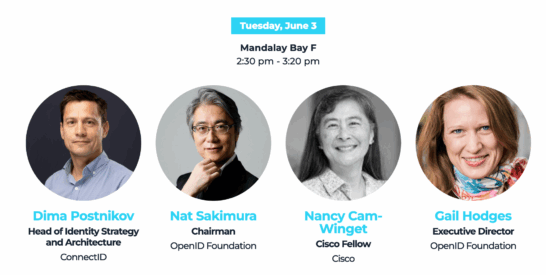
On June 3, 2025, an Identiverse 2025 session was held at Mandalay Bay F, where key members of the OpenID Foundation (OIDF) took the stage for an in-depth discussion of the current state of the identity industry, the role of interoperability events, delegated authority related to AI, and support for diverse ecosystems. This article summarizes the session’s key points for you.
The Mission and Activities of the OpenID Foundation (OIDF)
OIDF is a nonprofit open standards organization that aims to lead the community in developing secure, interoperable, privacy-preserving identity standards. Its work supports a wide range of use cases, including login, open finance, open data, open health, digital identity, and Shared Signals, indirectly benefiting billions of users and millions of applications.
A variety of working groups are active within OIDF.
- AB Connect: Responsible for specifications such as OpenID Connect and OpenID Federation.
- FAPI: High-security API protection specifications for open banking, open data, and open health.
- Shared Signals: Specifications described as the “nervous system” of any ecosystem.
- Digital Credentials Protocols: Includes OpenID for Verifiable Presentation and OpenID for Verifiable Credential Issuance.
- eKYC and IDA: Includes authority specifications used for delegated authority in AI, digital estates, age verification, and other purposes.
- AuthZEN: Standardization needed for externalizing authorization.
- IPSE: Integrates several important specifications for enterprise use and coordinates with specifications from other prominent standards bodies.
The Importance of Interoperability Events
An “enormous number” of interoperability events have been held over the past 9 months. Active interoperability testing is taking place across specifications such as Shared Signals, OpenID Federation, and OpenID for Verifiable Presentations.
These events mean more than merely technical validation.
- Catalysts for adoption: By demonstrating interoperability, the events encourage vendor participation and provide an opportunity to show industry leadership. Atul Tulshibagwale (CTO of SGNL) said that organizations such as Gartner “galvanize this whole thing.”
- Specification maturity: Interoperation among multiple vendors helps reconcile variations in how specifications are interpreted and increases their maturity. Nancy Cam-Winget (Cisco Fellow) emphasized that this ensures “not only interoperability, but the maturity of the specifications themselves.”
- Community building: The events foster a sense of community among participants and strengthen collaboration toward solving shared challenges.
Delegated Authority and AI: A New Frontier
The intersection of AI and identity was one of the session’s main topics. The rapid acceleration of AI adoption following the emergence of ChatGPT has created new security and privacy breaches, making identity more important than ever.
- AI-driven threats: There have been cases in which AI agents impersonated humans and instructed fraudulent transactions.
- The role of identity: Nancy Cam-Winget said, “If you cannot identify it, you cannot protect it,” emphasizing that identity is a top priority in AI.
- New challenges: It was noted that charging for traffic generated by LLMs (large language models), assuring the identity of LLMs themselves, and existing delegated-authority use cases such as “Death and the Digital Estate” and age verification have similarities to the requirements for AI agents.
- OIDF initiatives: OIDF is developing a white paper on AI, aiming to strengthen cooperation between the AI and identity communities and identify and address potential gaps. It is also considering establishing an AI-related community group.
Ecosystem Support: The Challenge of Global Standardization
OIDF actively supports 26 public- and private-sector ecosystems around the world. However, it faces the challenge that many of the rapidly proliferating laws and regulations worldwide—including more than 160 eID policies, more than 130 data privacy laws, and more than 90 open banking deployments—are not yet linked to underlying standards.
- Digital Public Infrastructure (DPI): OIDF supports areas of DPI including digital identity, open finance, open data, fast payments, electronic signatures, civil registration, and government services.
- Ecosystem Community Group: Co-chaired by Dima, this group focuses on reference architectures for open banking and data, coordination among specifications, and support for decision-making based on insights from other ecosystems.
- Focus on the Global South: It was emphasized that considering the requirements of the Global South, which accounts for 75–80% of the world’s population, is critically important. Natsuhiko Sakimura (Chairman of OIDF) pointed out that concepts taken for granted in the Global North, such as passwords, can become mechanisms that exclude them.
- Vendor perspective: Nancy Cam-Winget explained how important standardized, interoperable ecosystems are from a vendor’s perspective. They avoid the need for country-by-country customization and make it easier to deploy products globally.
- Cross-border interoperability: Ali Adnan (co-founder of Authlete) cited the acceleration of international money transfers in financial services and stressed the importance of robust ecosystems and the accurate implementation and testing of open standards.
Conclusion and Call to Participate
At the end of the session, the panelists delivered a strong message to attendees.
- “You are not alone”: People facing common business challenges can gain extensive expertise and support by joining OIDF community groups and working groups.
- Ease of participation: Participation in OIDF groups does not require membership; anyone can join simply by signing a contribution agreement, and all contributions are welcomed under the principle that “any idea is a good idea.”
- Rapid standardization: In response to a question from the floor about whether standardization takes too long, the panel noted that the standardization process is not necessarily slow and that a standard has been published in as little as 90 days.
The world of identity and standardization is evolving rapidly, and the rise of AI and diversification of global ecosystems are making it increasingly complex. However, organizations such as the OpenID Foundation are confronting these challenges by actively holding interoperability events, researching delegated authority and AI, and supporting diverse ecosystems around the world.
If you are interested in this field, please join the OpenID Foundation and help shape the future of identity together.
Related posts

I am running in the OpenID Foundation Board election (2025)
I have just declared my candidacy in the OpenID Foundation Board election (2025). If you are a member, I would greatly appreciate your seconding my nomination.…
【Breaking News】The Future of Digital ID Is Changing! OpenID Foundation Responds to Regulation and Market Competition with a Third-Party Certification Service!
The OpenID Foundation, which establishes international standards for digital identity, has announced that it will launch a new certification service in 2026, during the 2nd quarter!…

? A New Era for OpenID Has Begun! The Historic Achievement of ITU-T Standardization
May 29, 2025 - A truly history-changing moment has arrived in the world of digital identity! What Happened? The International Telecommunication Union (ITU) has formally adopted…