
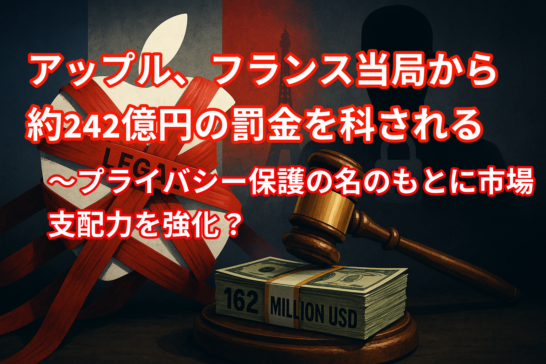
On March 31, the French Competition Authority (FCA) imposed a hefty fine on Apple totaling 100 million and 50 million euros (approximately ¥24.2 billion). At issue was a privacy protection tool called App Tracking Transparency (ATT), which Apple introduced between 2021 and 2023.
The tool was introduced under the stated aim of protecting the privacy of iOS users, but according to the French authority’s investigation, the way it was implemented raised competition-law concerns.
How ATT Works and Its Problems
ATT essentially requires apps to obtain explicit consent before collecting users’ data and using it for advertising purposes. At first glance, this may seem like an excellent consumer-protection feature, but the problem lay in how it was implemented.
Specifically:
- Third-party apps were required to display “excessively complex” pop-ups.
- Users became frustrated with the intrusive pop-ups, reducing consent rates.
- Apple’s own apps, by contrast, were designed to require only a single simple checkbox.
- Apple used data from users who had consented in its own advertising services and monetized it.
The authority noted that this design made it more difficult for other app developers to earn advertising revenue, while Apple itself collected and used personal data to profit from its advertising business.
Market Impact and the Authority’s Decision
According to the French Competition Authority, this system caused serious economic harm, particularly to small app publishers that depend on advertising revenue. Interestingly, the authority concluded that the problem was not the ATT privacy tool itself, but that the manner of its implementation was “neither necessary nor proportionate.”
The authority’s statement noted that “the rules governing the interaction between the various pop-up windows undermined the neutrality of the framework and caused clear economic harm to application publishers and service providers.”
What the Fine Means and What Comes Next
Although the ¥24.2 billion fine is negligible compared with Apple’s quarterly revenue (in the 2024 fiscal year’s 4th quarter, approximately ¥19 trillion), it carries important significance as a warning against major technology companies using privacy protection as a pretext for exerting market power.
Notably, the French authority did not require changes to ATT. Apple also commented, “We are disappointed with today’s decision, but the French Competition Authority has not required any specific changes to ATT,” and the feature itself is expected to remain in place.
This case highlights the difficult challenge of balancing privacy protection with fair competition in digital markets. Protecting user privacy is important, but the regulator’s position appears to be that it must not become a tool for strengthening the market power of a particular company.

References
- Ciblage publicitaire : l’Autorité de la concurrence prononce une sanction de 150 000 000 euros à l’encontre d’Apple en raison de la mise en œuvre du dispositif App Tracking Transparency (« ATT »)
- Targeted advertising: the Autorité de la concurrence imposes a fine of €150,000,000 on Apple for the implementation of the App Tracking Transparency (“ATT”) framework
- French regulator fines Apple $162 million for anticompetitive use of privacy tool
- Sanction: Apple condamné à 150 millions d’euros d’amende en France pour abus de position dominante
- CNIL: Applications mobiles : l’Autorité de la concurrence sanctionne Apple pour avoir abusé de sa position dominante
Related posts
Data Sustains Lives—MyDataConference 2026 Opening Address
The following is the opening address for the MyData Japan Conference 2026, delivered by Nat Sakimura in his capacity as Chair of the General Incorporated Association…

The MyData Conference 2026 Is This Wednesday. See You at Hitotsubashi Hall!
I have been posting announcements on X every few days, and the MyDataJapan Conference 2026 is this Wednesday. There are many highlights: Naohiro Fujie, Representative Director…
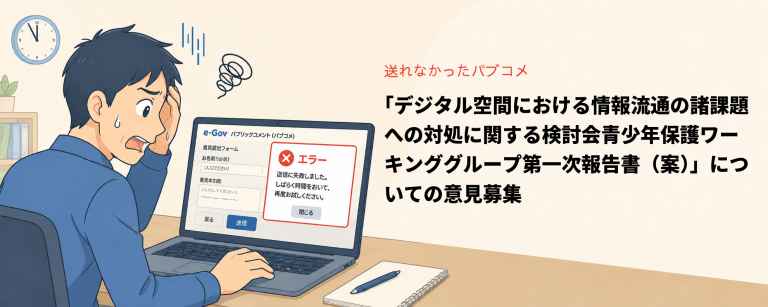
Unsubmitted Public Comment on the Call for Comments on the Draft First Report of the Youth Protection Working Group on Information Distribution in the Digital Space
July 823:59 was the deadline for the call for comments on the draft first report. I ended the FAPI WG early and23:40 began the submission process…