

710
VIEWS
This is slightly old news, but the OECD published an interesting document on February 5. 1
- Enhancing Access to and Sharing of Data in the Age of Artificial Intelligence
—Companion Document to the OECD Council Recommendation on Enhancing Access to and
Sharing of Data - Enhancing Access to and Sharing of Data in the Age of AI
—Companion Document to the OECD Council Recommendation on Enhancing Access to and Sharing of Data
The following is a broad summary of its contents. Please consult the original document for details.
Overview
- The OECD Recommendation on Enhancing Access to and Sharing of Data (EASD) provides a framework for maximizing the benefits of data while ensuring that rights are protected.
- It emphasizes a whole-of-government approach to data governance that integrates economic, social, and legal considerations.
- The Recommendation encourages voluntary adherence by OECD members and partners and promotes responsible data-sharing practices.
Key Concepts in Data Governance
- Data value cycle: This covers the entire data life cycle, from creation to deletion, and highlights the need for complementary resources such as algorithms and human skills.
- Data openness continuum: A framework that classifies access from closed to open data, enabling tailored sharing arrangements based on risk and trust.
- Data ecosystems: Various stakeholders, including data holders, producers, and intermediaries, interact to create value, requiring cooperation and trust to balance competing interests.
Principles for Enhancing Data Access and Sharing
- Strengthening trust: Engage stakeholders through consultation and transparency to build trust in data governance.
- Investing in data: Promote market-based approaches and sustainable business models to facilitate data sharing, including regulatory sandboxes for innovation.
- Effective use of data: Ensure that data is findable, accessible, interoperable, and reusable (the FAIR principles), and facilitate cross-border data sharing.
Practical Applications and Impacts
- Governments should adopt national data strategies aligned with the EASD principles to promote responsible data governance.
- Coherent legal frameworks are needed to support data sharing while protecting privacy and intellectual property rights.
- Successful examples from various countries demonstrate the importance of public-private partnerships and stakeholder engagement in enhancing data access.
Strengthening Data-Sharing Infrastructure
- Centralized data repositories: Establish centralized infrastructure to facilitate efficient information sharing among public institutions, improve service delivery, and support data-driven public policy.
- Public engagement: Promote responsible data-sharing practices to improve public understanding of the benefits and risks of a data-driven economy.
- Stakeholder input: Involve stakeholders in regulatory discussions to address AI-related risks without hindering innovation.
Implications for Competition Authorities
- Market dynamics: Consider the effects of multisided business models that offer free products in exchange for consumer data and may entrench market power.
- Demand-side characteristics: Recognize that data can affect market dynamics, search costs, switching costs, and consumer choice, potentially reinforcing dominant market positions.
Responsible Data Sharing in Research
- Research data sharing: Follow guidelines aligned with the Australian Code for the Responsible Conduct of Research to promote data sharing among institutions and researchers.
- License classification: Develop a classification of data licenses to clarify responsibilities and rights associated with the use of data in AI and machine learning.
Open Government Data and AI
- Importance of open data: Open government data is essential for developing and training AI systems and serves as a trustworthy input.
- Risk management: Open data helps manage risks related to data provenance and source reliability, enhancing the integrity of AI applications.
Concluding Insights
- The OECD Recommendation on EASD provides a comprehensive framework for enhancing data access and sharing, emphasizing trust, investment, and effective governance.
- Implementing these principles could improve public services, foster innovation in the data-driven economy, and advance the development of responsible AI.
- Continued stakeholder engagement and adherence to established guidelines are essential to realizing the full potential of data-sharing initiatives.
Policy Brief:
A related Policy Brief was also published in 3/8.
Footnotes
- On February 6, it also published a Policy Brief on this subject.
Related posts

When Software Becomes Staff: Governance, Security, and Safety for Agentic AI
Below is the transcript of my keynote speech at EIC 2026 on May 19, 2026. The slides are provided as a PDF at the end of…
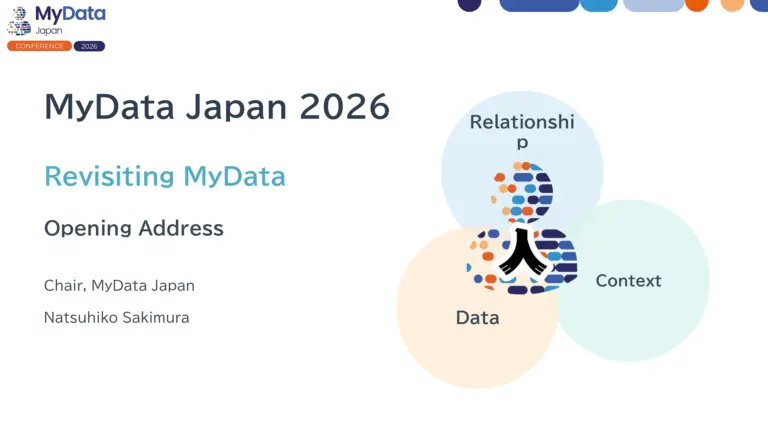
Data Sustains Lives—MyDataConference 2026 Opening Address
The following is the opening address for the MyData Japan Conference 2026, delivered by Nat Sakimura in his capacity as Chair of the General Incorporated Association…

The MyData Conference 2026 Is This Wednesday. See You at Hitotsubashi Hall!
I have been posting announcements on X every few days, and the MyDataJapan Conference 2026 is this Wednesday. There are many highlights: Naohiro Fujie, Representative Director…