Long ago there was something called the #7BookCoverChallenge, intended to help promote a culture of reading. “To participate, post a photograph of the cover of one favorite book each day for 7 days. Upload only the cover image, without explaining the book, and each day tag and invite an SNS friend to join the challenge.” However, mindful of the Ministry of Internal Affairs and Communications guideline1, I did not pass it on. Instead, I added reviews and posted them on Facebook. This was 4 years ago, on June, in the midst of COVID. Facebook posts drift away and become hard to access, so I would like to reproduce them here.
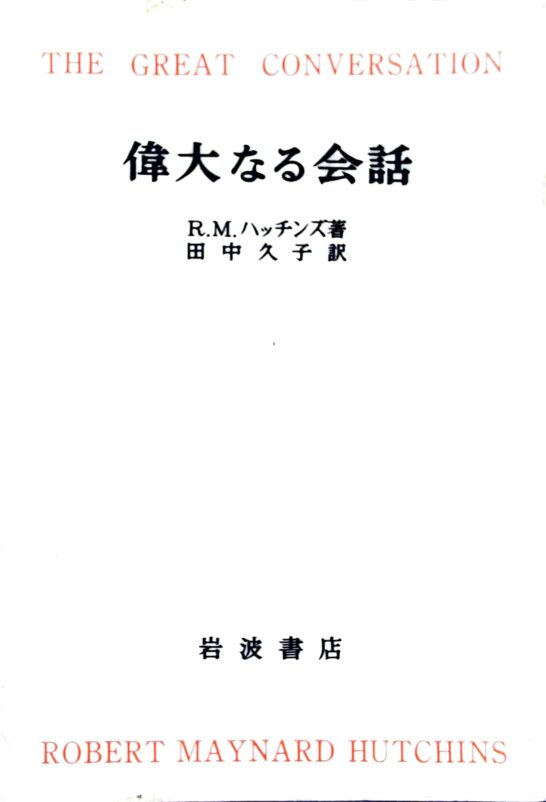
Day 1: Hutchins, “The Great Conversation” (translated by Hisako Tanaka)
For day 1, I chose “The Great Conversation” by Robert M. Hutchins, a giant of American education who became president of the University of Chicago at the young age of 30 and held that post for 21 years. Iwanami Shoten published this Japanese volume by combining the original work’s 2 separate volumes, “Education for Freedom” and “The Great Conversation,” into 1 volume.
“Education for Freedom” begins with a chapter entitled “Autobiography of an Uneducated Man” and argues for the importance of the liberal arts.
“The liberal arts are literally the arts of freedom. To become free, a person must understand the tradition he has inherited and within which he lives. … Ultimately, to educate students to become free persons, they must be taught in the fields of the liberal arts and the great books2.”
I probably read this in my third year of junior high school. I was living in Nairobi then, so Japanese books were difficult to obtain. I took it from a shelf in my father’s study. My father’s notes in the book were also very helpful in identifying important passages. It was probably the single book that most influenced the person I later became. Regrettably, even now, long after passing the age at which Dr. Hutchins left the University of Chicago, I myself remain uneducated.
The fact that such an excellent book is out of print and cannot be read seems like a failure of copyright law. Once a book goes out of print, I wish it could be made available electronically, with royalties paid to the rights holder per copy3.
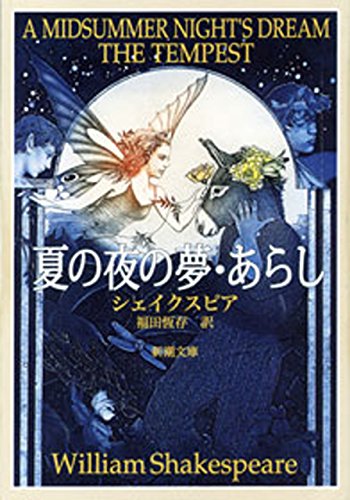
Day 2: Shakespeare, “The Tempest” (translated by Tsuneari Fukuda)
For day 2, I chose Shakespeare’s final work, “The Tempest,” translated by Tsuneari Fukuda. I hesitated because many people would surely choose it, but I thought the meaning of books discussed later would change depending on whether this one was included, so here it is.
As Shakespeare’s last solo work, it is regarded as the culmination of his creative career. It profoundly influenced later literature and art and inspired many adaptations and interpretations. Sometimes called a purified “King Lear,” its themes are said to include “revenge and forgiveness” (Prospero’s change of heart is central), “civilization and savagery” (a critical portrayal of colonialism through Caliban), “art and reality” (Prospero’s magic can be read as a metaphor for art), and “freedom and bondage” (symbolized by Ariel’s release). Miranda’s famous line near the end is: “How beauteous mankind is! O, brave new world”4.
The edition in our home when I was in high school did not, I think, have such a flashy cover, but it was certainly Fukuda’s translation, so I have shown this cover. Unfortunately, the line above is translated differently and does not contain “brave new world.”
Day 3: Plato, “The Republic” (translated by Norio Fujisawa)
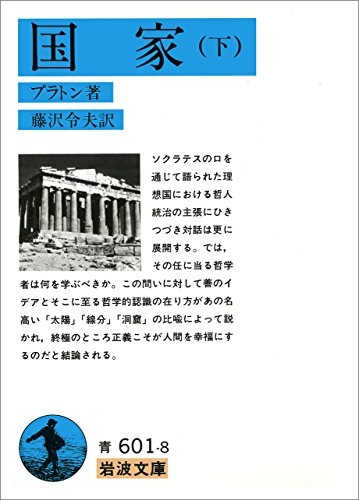
For day 3, I chose Plato’s “Republic.”
This well-known foundation of the Western system of knowledge is essential reading even in modern Japan, which exists under its influence. Naturally, Hutchins, discussed on day 1, also regards it as required reading.
Reading it reveals that many modern disciplines were built on this foundation and remain within its framework. Economics, which I studied, follows the framework presented here: establish the existence of the ideal form (prove the existence of general equilibrium), prove its optimality (prove Pareto optimality), and seek the second-best means of bringing reality closer to it (taxation theory, redistribution theory, and so forth).
It is also a book that makes us recognize how often, precisely as his framework indicates, we travel in the direction opposite to the one we should take.
The discussions of constitutional change5 and the allegory of the cave are often excerpted (both appear in the second volume, so I used that cover). Yet I understand the book’s essence to be its account of what justice, happiness, and the love of wisdom are. It also explains the importance of education toward those ends and the significance of the so-called liberal arts—the quadrivium of arithmetic, geometry, music, and astronomy—and of the logos that unifies them. This may also explain why such disciplines rank above practical studies in the Western system of learning.
As an ignorant and uneducated person, I can hardly hope to understand the whole, but I want to deepen my understanding little by little. I earnestly hope that as many people as possible will learn from this book.6
Day 4: Huxley, “Brave New World” (translated by Tatsuo Matsumura)
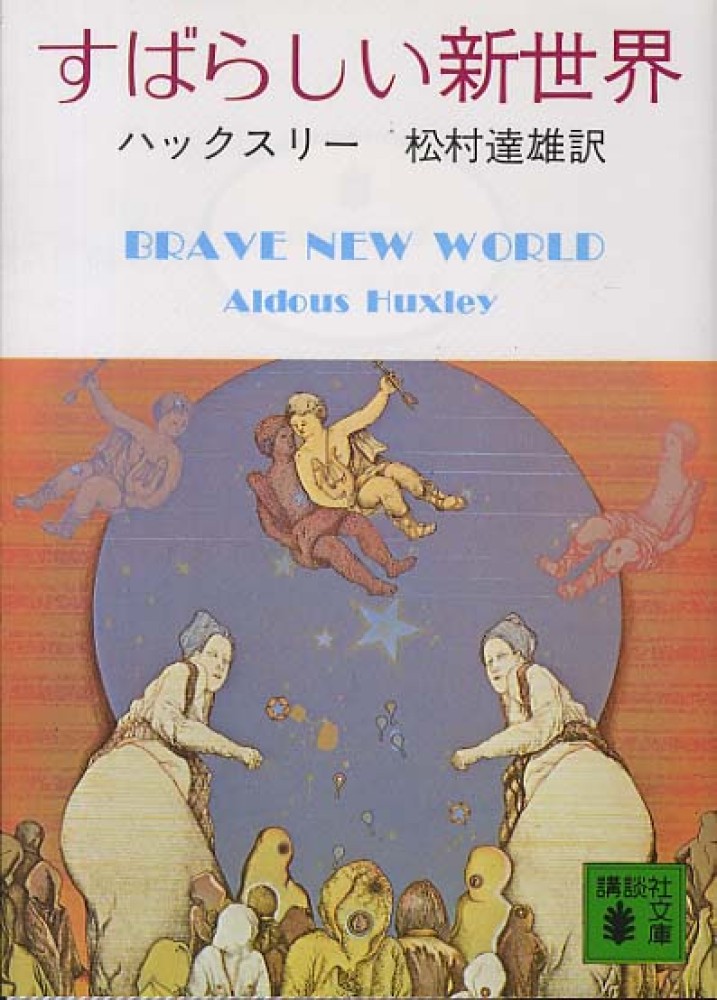
For day 4, I chose Aldous Huxley’s “Brave New World.”
It is a representative dystopian novel alongside “1984” and “Animal Farm,” but seems more highly regarded than they are within English literature. Perhaps this is because works such as “1984” model their dystopias on the Soviet Union, whereas “Brave New World” is based on the global capitalist society in which we now live. Its concepts probably apply directly to our modern lives. And within that world is John the Savage, who can recite Shakespeare by heart… I will stop here to avoid spoilers.
Is the conventional assessment that it depicts a superficially happy “hell,” contrasted with Shakespeare? Indeed, the title “Brave New World” quotes Miranda’s line “O brave new world” in “The Tempest,” discussed on day two (Act 5, Scene 1). The Shakespearean world is taken as ideal, while modern society is portrayed as hell. After all, people make the sign of the T from the Model T Ford rather than the sign of the cross.
Yet I doubt this interpretation. Indeed, I somewhat doubt whether it is a dystopian novel at all. Huxley’s brother was certainly a scholar of eugenics, and Aldous probably reacted against it. But what of the shock of the explanation John the Savage receives from Mustapha Mond, the ruler of this world? And why does John make the choice he does?
In my view, regarding this novel as a celebration of Shakespeare may be excessively romantic. Rather, it should be read against Plato’s “Republic,” discussed on day three. Yes: “Brave New World” is nothing other than a modernization of Plato’s ideal world, the philosopher-state. If we experience it as hell, might we be poisoned by the foolishness of what Plato calls the “democratic state”?
“Brave New World” is a novel that holds such a sharp blade to the throats of people like us who love Shakespeare and believe in liberal democracy.
Day 5: Shuji Fujisawa, “The New Mozart Poisoning Case”
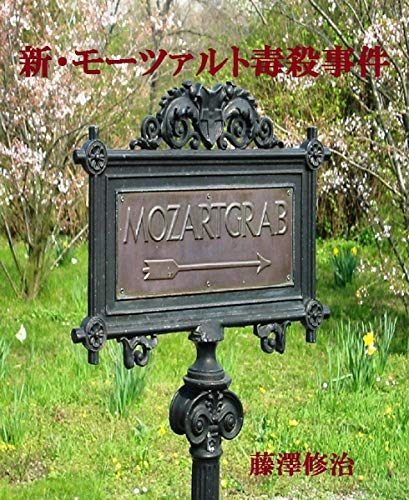
I followed an extremely serious path through the halfway point on day 4, so from day 5 I want to loosen up a little. I considered choosing Mozart’s Symphony No. 41, but thought that might still be too serious (yes, it would simply continue from Plato), so for something a little more sensational I chose Shuji Fujisawa’s “The New Mozart Poisoning Case.”
There are many suspicious aspects to Mozart’s death. People often say that in his final years Mozart was destitute and deeply in debt, but his actual income and expenditures tell a completely different story. He was an enormously popular composer earning tens of millions of yen every year. In just his final six months, he earned 30 million. Meanwhile, he lived modestly—or perhaps had no time to spend money—so his account books reveal massive annual surpluses in the tens of millions. Account books: Mozart was extremely methodical and kept careful ledgers. This too contrasts with his image from plays and films, but on reflection, one could not write such finely detailed music otherwise. So what were those letters asking for loans…?
Against that enormous income, even Constanze’s treatment costs were trivial. Indeed, was Constanze actually ill in the first place? Why did Mozart suddenly go to Berlin? Why did Constanze never even visit his grave? And why was that famous Mozart portrait left unfinished? Behind all this is Mozart’s great love affair, making matters even more complicated. The story of Mozart we thought we knew crumbles completely.
The book also traces documentary evidence such as cemetery records of bodies received, identifies records that should exist but are missing, and infers the reality emerging from those gaps: what was concealed was an inconvenient truth. Behind it all lay conflict between a newly installed conservative monarch, replacing an enlightened ruler, and Mozart, the world-famous champion of the Enlightenment. Truth (?) really is stranger than fiction. Even non-music fans can enjoy it, and it impresses on the reader the importance of following the numbers. I am certain you will enjoy it.
- https://amzn.to/2ZiUtsV is out of print. Its successor is probably https://amzn.to/3zpRt3W
Day 6: Megumi Kino’s “Saya to Soyogeru Tama no O no” (1984) and “The Four Seasons of Fumufumu Land” (1987)
I learned about the poet Megumi Kino, who was born the same year as I was, when I was in high school, probably around 1982. I remember my father returning to our home in Nairobi from Japan and saying with enormous delight, “An extraordinary poet has appeared.” Apparently he had met her or been introduced to her at the Mirai Tanka Association when he stopped by during a visit to Japan. The poem he recited was:
In every hue, iroha nihoheto chirinuru wo; a rose is a rose, forever and utterly a rose.
I was struck by lightning. A genius, I thought. First year of high school? 1nd year? 2rd year?
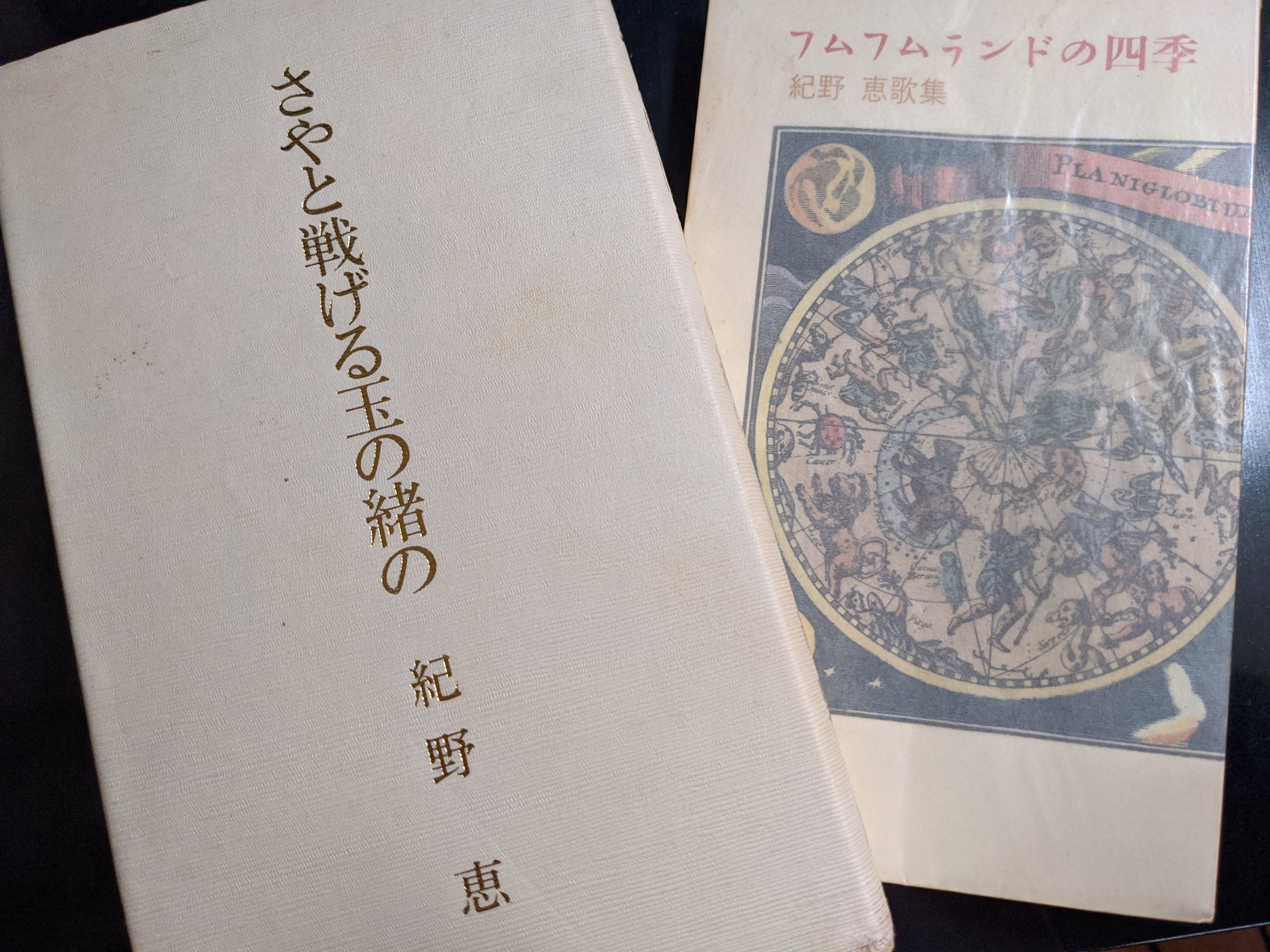
It appears in “Saya to Soyogeru Tama no O no.”
“The Four Seasons of Fumufumu Land” is a collection of poems from her university years.
The pale-blue boarding ticket is like the wing of a frozen butterfly as I walk the pier.

“Words destined to be scattered and spent between the waves.” “That is what one calls selfish, Oefu.”

A winter morning, after passing Cape Shiono, neither yesterday’s things nor tomorrow’s.
These and other richly evocative poems fill the collection. They are poems in a Shin Kokin style, the opposite of the plainness of “Salad Anniversary” by Machi Tawara, who was 3 years older and became a sensation around the same time.
Both of these 2 books were left by my father. I did not actively follow her work afterward, but suddenly remembered it during the Book Cover Challenge.
What kind of poems is this precocious genius writing now?
I felt like looking into it.
- Saya to Soyogeru Tama no O no (National Diet Library)
- The Four Seasons of Fumufumu Land (National Diet Library)
Day 7: And on day 7…
When I originally wrote this in 2020, it ended with day 6, because I introduced two books on day 6. Looking back, however, I am surprised that almost everything is out of print. So I will add one more work.
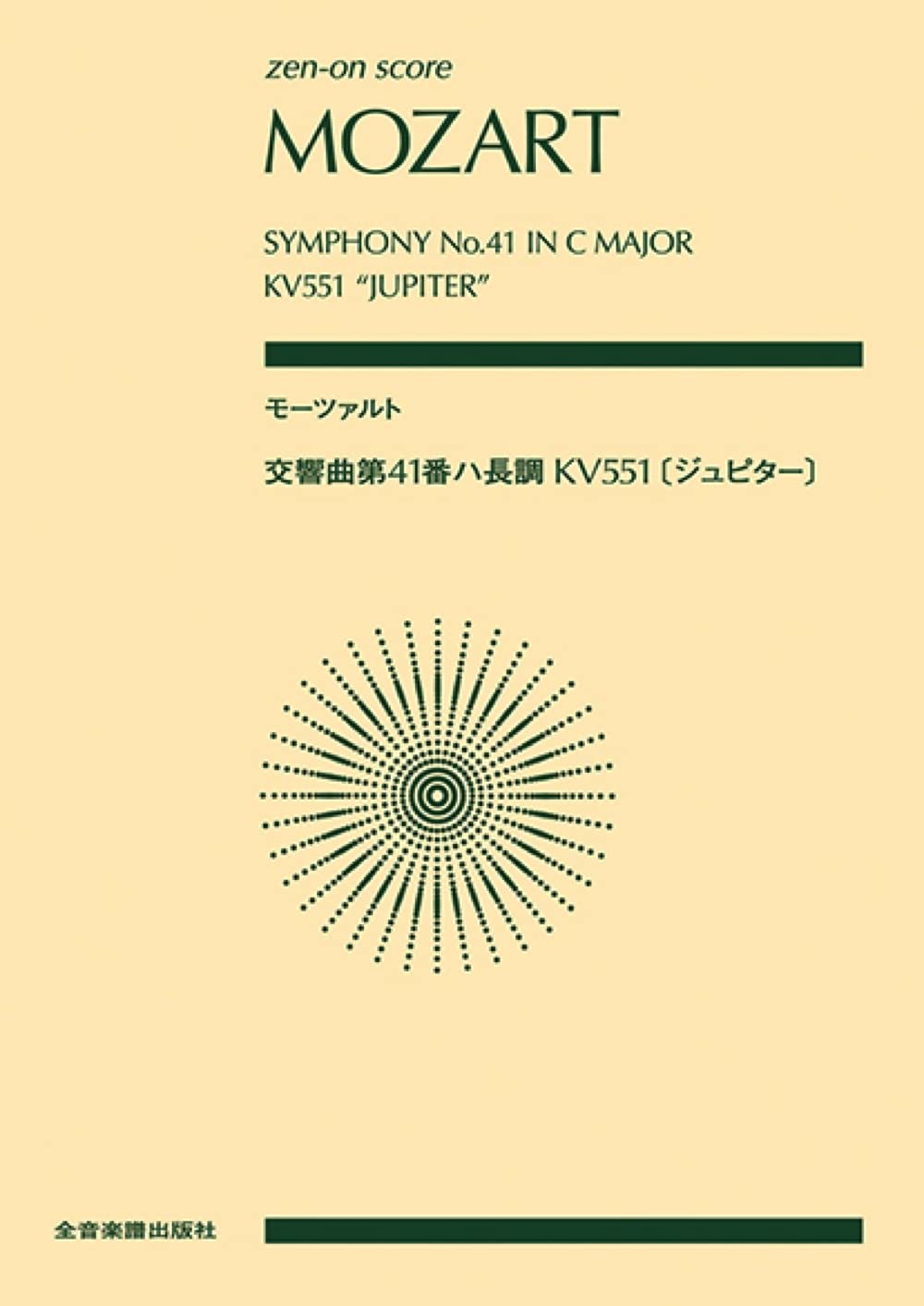
It is Mozart’s “Symphony No. 41, ‘Jupiter.’”
On day 5, I wrote that Mozart was a meticulous person, the opposite of the irresponsible, mad genius portrayed in the play “Amadeus.” We can see this in his bookkeeping and in his own statement that nobody worked harder than he did. But the clearest evidence is surely the scores he left. It is said that one cannot grasp the true value of classical music without seeing the score, and this work exemplifies that claim. Written with chilling precision, it embodies music as the discipline that extends arithmetic through time to converse with God. I think the following video makes this clear.

Thus day 7 was Mozart’s “Jupiter.”
Footnotes
- If you receive chain mail, please stop forwarding it!
- books that, through the liberal arts, provide a clear and vital understanding of our tradition: a system extending from Plato and Aristotle onward
- the English edition is naturally available
- author’s translation
- the section on changes of political regime predicts the emergence of Hitler and Trump
- Of course, it has many imperfections: things clearly wrong from our modern perspective (geocentrism), and places where Plato himself speaks of “opinion” as though it were knowledge.
Related posts
Twitter Renga (collaborative linked verse)
At the after-party following a GLOCOM study session, we composed a Twitter renga, among other things. Links to the original tweets and such can be found…

Of August
After the late-August typhoon, in the autumn sky, mackerel-scale clouds seem to be falling.
Happy New Year
I look forward to your continued support this year. At dawn, Saruko crosses the handwoven stripes; the days I cherished are far away. I am sorry.…
You must be logged in to post a comment.