

First, a word for people in the identity industry
To begin with, anyone interested in identity should read this book, The Evolution of the Metaverse. By using the metaverse and virtual female embodiment to free existence from the physical constraints of reality and make it manageable in an abstract space, the issues and requirements of identity and privacy management become astonishingly clear. The book says:
- To begin with, “identity is the ‘recognition’ of what we understand ourselves to be and the ‘sense’ that this is acknowledged by other people and society.”
- In physical reality, we essentially had no choice but to accept the name, appearance, and voice we were born with. In other words, identity was something “given” to us.
- Unlike identity in the age of physical reality, when one essentially had no choice but to “accept” something fixed and given, identity in the metaverse age becomes something one freely “designs,” making it possible to live as the person one wants to be.
- Seeing a human being as a divisible “dividual”
- Freely designing one’s life by “switching” among multiple identities
- Plato’s theory of Forms—the reality we see is not the substance itself, but merely a shadow of the Forms
- A metaverse where one can freely design one’s identity and become the person one wants to be
(Source) The Evolution of the Metaverse
People familiar with my book1, blog, or lectures will probably think, “Yes, yes, that idea.” The following diagram is one I have reused since June 2011, when I wrote Introduction to Digital Identity for Non-Technical Readers, and it says almost the same thing. Although the terminology differs—dividual versus identity (partial identity), for example—the concepts can almost entirely be mapped to one another.
The book, however, is probably 100 times easier to understand. I suspect this is because it gives the abstract concept called the self-image in this diagram the tangible form of an avatar, while also explaining it through categories such as the “world of words,” “visual world,” and “acoustic world,” rather than lumping everything together as an “attribute.” Of course, there is also simply a difference in writing ability.
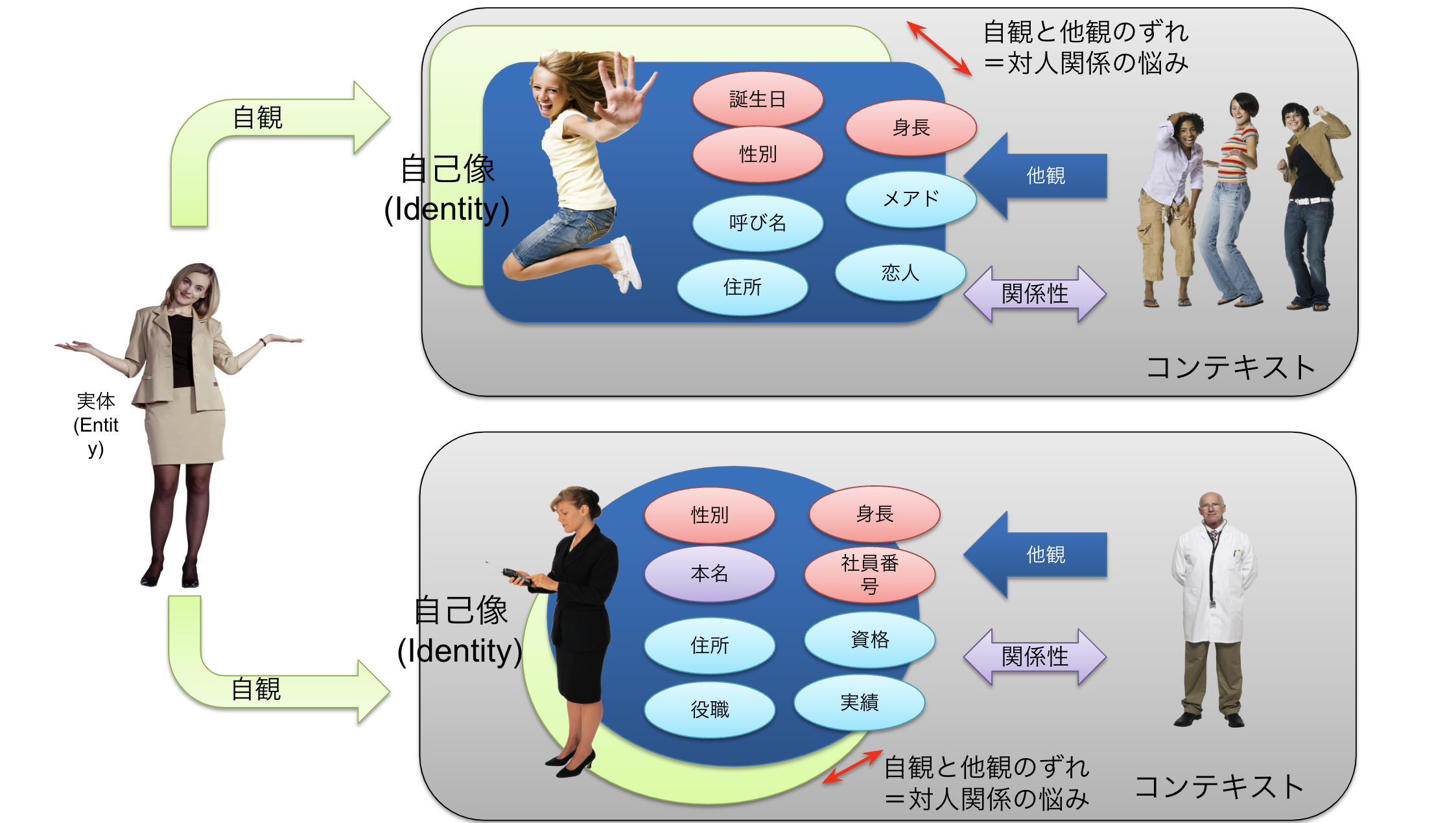
Figure 1: Self-image (identity) and the pursuit of happiness
What is particularly important is the freedom of the soul and the idea that identity is not something given by others but something established by oneself. Many people, even among “identity experts,” forget this. Many still hold the medieval idea that identity is something bestowed by God, government, or some other authority and then accepted.
Medieval identity versus modern identity
The principal differences between the modern and medieval views of the individual can be summarized as follows.
The medieval view of the individual
- The individual existed as part of a community and was defined by the role and status assigned by that community.2
- Under the influence of Christianity, the individual was understood in relation to God as an “individual outside the world.”3 4
- Belonging to the community and one’s role within it were valued more than the individual’s inner life.5
The modern view of the individual
- The individual came to be understood as an autonomous being, with greater emphasis placed on the individual’s inner life and sense of self.67
- Under the influence of the Enlightenment, the individual was freed from the constraints of medieval communities and came to experience “inner loneliness.”8
- Individual rights and freedoms were emphasized, and individualistic values emerged.910
- The concept of privacy was born, and the private sphere came to be regarded as sacred.11
In other words, while the medieval individual was understood as part of a community, modernity emphasized the individual’s autonomy and inner life and established individualistic values. One might also call this the freedom of the soul. Unfortunately, quite a few people have not yet reached this individualistic value system or modern view of the individual. That leads to ideas such as requiring an avatar to resemble one’s real-world self, or putting a government-issued proof of personal attributes (PID) in an identity wallet and organizing everything around it.
This is not limited to wallets. Something similar happens with identity verification on Web 2.0-style social networks. In a recent experience, I was told that to become verified on LinkedIn, my name had to be identical to the one in my passport. A passport name is something registered with a government as an identifier for crossing borders; it is not an expression of oneself. I work in English as Nat Sakimura, but “identity verification” forces me to become Natsuhiko Sakimura. What is that supposed to mean? Doing so would sever the link to my past achievements. No, it is not such a trivial matter. Taking away someone’s chosen name is tantamount to denying their personhood, just as Yubaba takes Chihiro’s name in Spirited Away.
Just as the book says, a name is one’s “identity in the world of words.” This “freedom to name oneself” is extremely important. As the book says, this is because “by continually being addressed every day by the people around me with this ‘word-spirit,’ I can acquire a self-recognition as ___.”
Needless to say, freedom in one’s “avatar: identity in the visual world” (the book’s phrase) is also important. This is because “when I regard it as an ‘expression of my identity,’ I do not want to be constrained to a ‘human’ form like that of reality” (the book). Or are we to say that if a person has impaired limbs, their limbs must also be impaired in the metaverse?
The symbol of that freedom is virtual female embodiment. In Japan, acceptance has advanced considerably against the cultural background of ningyo joruri puppet theatre and female roles in kabuki, but in the West it could, at worst, be treated as 56. Whether someone can accept virtual female embodiment is a litmus test for latent prejudice.
The book mentions the possibility that Meta may impose restrictions, and I would not be surprised if Apple did so with Vision Pro as well. They might claim that it is a UX decision intended to make VR avatars easy to create. But such moves must be resisted thoroughly. In Japan, the right to become the person one wants to be should be recognized under theories of the right to control one’s self-image and the “right of self-determination concerning appearance and grooming.” Under the theory of indirect application, companies such as Meta should not be permitted to violate this right12.
These discussions of identity are collected in Chapter 4, so if you are short on time, I hope you will at least read that chapter first.
Also instructive regarding privacy
Unlike identity, privacy does not have a chapter of its own, but the book contains many passages that are instructive on privacy as well. For example:
- Likewise, in the traditional Japanese performing art of ningyo joruri, the middle-aged man dressed in black behind a beautiful female puppet dancing gracefully is plainly visible. Pointing that out, however, would be boorish.
This connects to a basic principle of data protection: “Even if data is visible, it must not be used for purposes other than those intended.” It is what I have long called “adult privacy”. It goes without saying that the ability to “become the person one wants to be” is inseparable from the “right to control one’s self-image”13.
ISO has now begun considering privacy in the metaverse, and I would very much like the people involved to read this book. I want an English edition.
And, of course, an explanation of the metaverse
I plunged straight into those specific issues because I work in identity and privacy, but the book is, fundamentally, a book about the metaverse. It carefully explains, with supporting data, subjects such as the “definition of the metaverse: seven requirements for its realization,” an introduction to the 4 major social VR platforms, the technologies supporting them, the characteristics of metaverse residents, and why people adopt virtual female embodiment. It is also packed with memorable phrases that make you want to underline them. Here are some examples:
- Voice: identity in the acoustic world
- The Proteus effect acting on one’s own mind
- Virtual female embodiment is a dry landscape garden—an extension of the culture of seeing one thing as another.
- In society today, it is natural to “continue learning new things forever.” In a society where everyone must accept being forever “immature,” the new value that replaces “self-respect as an adult” is “kawaii”: a value that finds one another’s “immaturity” endearing.
(Source) The Evolution of the Metaverse
I found myself reading it on Kindle while highlighting passage after passage. The examples above are only a small selection. I strongly encourage you to buy and read this book.
Even better when accompanied by the video explanation
Although the book is an excellent written introduction, video is naturally better suited to conveying an image of the metaverse. In that sense, I also recommend watching “I May Be a Virtual Girl, but I Spoke at the United Nations,” a presentation that the author, Virtual Girl Nem, gave at the UN IGF 2023. It is an extremely clear presentation, though it is in English….

This is a recording from the United Nations-sponsored Internet Governance Forum14, IGF 2023 Kyoto, Day 0,
- “Event No. 134: Talk with Metaverse residents – a new identity and diversity | Internet Governance Forum” (October 8, 2023, 18:00–19:00),
I was at the IGF venue that day because I had my own session15, but regrettably I could not attend this one in person. I think I was probably talking with someone from the OECD at that time about Trusted Data Intermediaries (TDI).
So, to sum up:
I truly recommend this book. Reading it on the plane from San Francisco, tears began to flow naturally when I reached Chapter 4. Please buy it and read it!
Change History
- 2024-04-23 First edition
- 2024-04-24 Added “Medieval Identity versus Modern Identity” and changed the writing style from polite to plain form.
Footnotes
- Natsuhiko Sakimura, Digital Identity, Nikkei BP (2021)
- Masaaki Shinya, “The Birth of Loneliness in Modernity,” Bukkyo University Sociology, No. 26 (2001)
- Masaaki Shinya, “The Birth of Loneliness in Modernity,” Bukkyo University Sociology, No. 26 (2001)
- Ryuji Fujimoto, “Individualism and the New Age Movement in America—Problems and Challenges of Contemporary Religion,” Studies in Contemporary Sociological Theory (2007)
- Kinya Abe, “Preliminary Considerations on the Formation of the Individual (Personality) in the Medieval West,” Center for Historical Social Science Literature, Hitotsubashi University, Study Report, 20 (1990)
- Masaaki Shinya, “The Birth of Loneliness in Modernity,” Bukkyo University Sociology, No. 26 (2001)
- Ryuji Fujimoto, “Individualism and the New Age Movement in America—Problems and Challenges of Contemporary Religion,” Studies in Contemporary Sociological Theory (2007)
- Ryuji Fujimoto, “Individualism and the New Age Movement in America—Problems and Challenges of Contemporary Religion,” Studies in Contemporary Sociological Theory (2007)
- Wikipedia, “Individualism
- Ryuji Fujimoto, “Individualism and the New Age Movement in America—Problems and Challenges of Contemporary Religion,” Studies in Contemporary Sociological Theory (2007)
- Wikipedia, “Individualism
- naka2656: “Pardon my presumption. I believe that the right to become the person one wants to be is recognized under theories of the right to control one’s self-image and the ‘right of self-determination concerning appearance and grooming,’ and that under the theory of indirect application, companies such as Meta should not be permitted to violate this right.” https://twitter.com/so6287/status/1781800580421398972
- “Privacy is the freedom to use different self-images according to the diversity of social relationships that human beings may freely form” (the right to control one’s self-image, premised on free social relationships). Source: Kaiko Muneyoshi, A New Framework for Human Rights Theory, Shinzansha (1992), pp. 187–195.
- Internet Governance Forum
- IGF 2023 Day 0 Event #42 “Trusted Personal Data Management Service (TPDMS)” Program
Related posts
Data Sustains Lives—MyDataConference 2026 Opening Address
The following is the opening address for the MyData Japan Conference 2026, delivered by Nat Sakimura in his capacity as Chair of the General Incorporated Association…

The MyData Conference 2026 Is This Wednesday. See You at Hitotsubashi Hall!
I have been posting announcements on X every few days, and the MyDataJapan Conference 2026 is this Wednesday. There are many highlights: Naohiro Fujie, Representative Director…
Unsubmitted Public Comment on the Call for Comments on the Draft First Report of the Youth Protection Working Group on Information Distribution in the Digital Space
July 823:59 was the deadline for the call for comments on the draft first report. I ended the FAPI WG early and23:40 began the submission process…
You must be logged in to post a comment.