

At noon Japan time on March 26, I delivered the opening address at National Australia Bank’s Corporate Digital ID Roundtable. National Australia Bank, commonly known as NAB, is the commercial bank with the largest assets in Australia.
Program
The program for the Corporate Digital ID Roundtable was as follows. (An English rendering of the Japanese section follows.)
Corporate ID in a nutshell
- What is the purpose and benefits of Corporate Digital ID?
- What are the current pain points for ID&V for corporate entities?
- What are the similar and unique challenges for Corporate Digital ID vis-a-vis Individual Digital ID?
- Is a common framework linking Individual Digital ID and Corporate Digital ID necessary/desirable? Why/Why not?
Spotlight on the Global LEI systems (as a potential global and interoperable framework for Corporate Digital ID)
- What are the origins of the GLEI, how does it operate and what is its purpose?
- What are the key adoption challenges and opportunities?
- A role for global standards?
- What’s needed for success?
Industry / Government / Cross-border collaboration and partnerships
- What is the role of Government/Industry in Corporate Digital ID ecosystems (how does this differ from Individual Digital ID)?
- What are the opportunities for industry collaboration, public-private partnerships?
- What are the opportunities for cross border co-operation to promote adoption and interoperability of corporate digital ID systems like the GLEI system?
- How do we ensure interoperability, accommodate within the broader framework of Digital ID in Australia where this is warranted/desirable
Conclusion and next steps
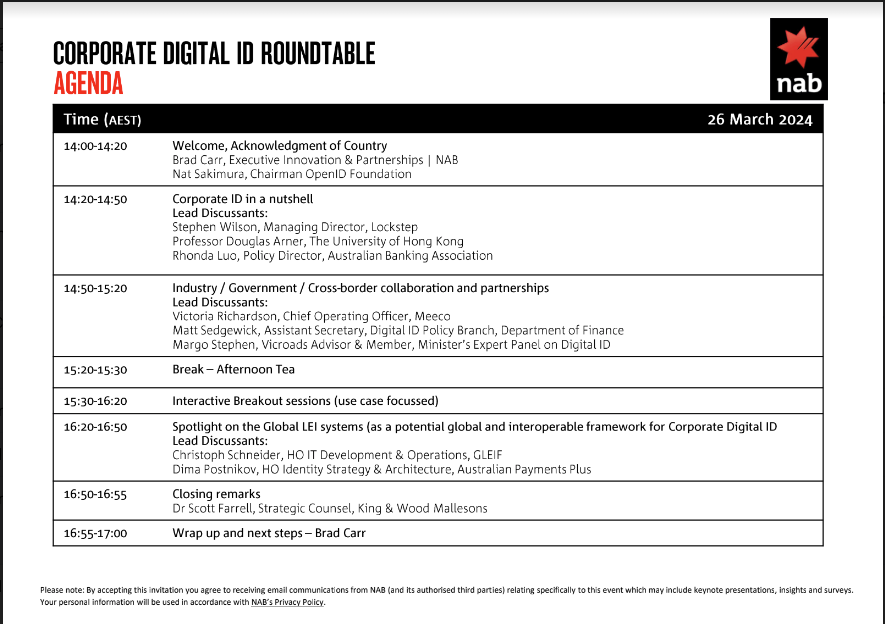
Corporate ID in a Nutshell
- What is the purpose and what are the benefits of Corporate Digital ID?
- What are the current pain points in ID&V for corporate entities?
- What challenges are shared by Corporate Digital ID and Individual Digital ID, and which are unique to Corporate Digital ID?
- Is a common framework linking Individual Digital ID and Corporate Digital ID necessary or desirable? Why or why not?
Spotlight on the Global LEI System (as a Potential Global and Interoperable Framework for Corporate Digital ID)
- What are the origins of the GLEI, how does it operate, and what is its purpose?
- What are the key adoption challenges and opportunities?
- What role should global standards play?
- What is needed for success?
Industry / Government / Cross-Border Cooperation and Partnerships
- What is the role of government and industry in Corporate Digital ID ecosystems, and how does it differ from their role in Individual Digital ID?
- What opportunities exist for industry collaboration and public-private partnerships?
- What opportunities exist for cross-border cooperation to promote adoption and interoperability of corporate digital ID systems such as the GLEI system?
- How do we ensure interoperability and accommodate it within the broader framework for Digital ID in Australia where warranted or desirable?
Background Reading
The background reading specified for this roundtable was the Bank for International Settlements (BIS) paper by Douglas Arner and others, “Corporate digital identity: no silver bullet, but a silver lining.” Douglas Arner also participated in the roundtable.
Speech
In response, I delivered the following speech as the opening address. (An English rendering of the Japanese section follows.)
Introduction:
Thank you for the introduction and thank you for inviting me to this roundtable. It is my honour to be with you all. Let me provide a few remarks on Corporate Digital Identity.
Corporate digital identity, or corporate ID, has the potential to dramatically simplify the identification and verification of companies, reducing the risks and costs of doing business. It can act as an admission ticket for companies to access financial services more efficiently. But developing effective corporate ID systems requires addressing several key challenges. I have enumerated seven of them for today.
Key points:
- Corporate ID is more complex than individual ID. A company’s attributes like directors and ownership structure can change frequently and span multiple jurisdictions. Identifying ultimate beneficial owners is a particular challenge.
- Company registries play a foundational role as the authoritative source of core company data. But many registries need to enhance data openness, quality, depth and connectivity to better support corporate ID. Often, data do not get updated in a timely manner and we would be looking at stale data.
- With Bank-related initiatives: Banks have an opportunity to monetise their KYC investments by providing corporate ID services, thus turning a cost centre into a profit centre. The Open Digital Trust Initiative, jointly launched by the Institute of International Finance and the OpenID Foundation is such an initiative, but face obstacles around cost, data sharing, liability and competition. KYC utilities offer potential but have seen mixed results so far.
- The Legal Entity Identifier (LEI) provides a global, unique, and interoperable identifier as a starting point for corporate ID. Enhancements like the verifiable LEI and LEI embedded in digital certificates could expand benefits and adoption. However, coverage of the registered companies is yet to be improved. Also, vLEI being built on a completely different technical stack than other verifiable credentials systems may pose adoption challenges.
- OpenID, an open standard and decentralized authentication protocol, and its extension “OpenID for Identity Assurance”, which expresses the provenance and quality of the attributes, have significant potential for enabling secure and trusted identity assurance and data sharing between companies and service providers. The Global Assured Identity Network (GAIN) initiative aims to build on banks’ existing KYC processes and the OpenID standard to create a global, interoperable corporate ID and authentication system. It is like building bridges among islands of ecosystems. Interoperability among different ecosystems has been demonstrated through a technical proof of concept, which was led by Dima Postonikov in the Sydney room, but business and operational reality must catch up before it becomes ready to take off.
- Decentralized identifiers and verifiable credential models, sometimes built on blockchain, aim to give companies more control over their data while enabling trusted data sharing. However, significant infrastructure investment and maturity are still needed.
- Some governments are proactively developing corporate ID infrastructure as a public good, such as the account aggregator framework in India which empowers SMEs to digitally share their data for better access to finance. While it has found tractions in these economies, whether the pattern will propagate to other parts of the world is yet to be determined.
Conclusion:
In summary, corporate ID is progressing but remains fragmented today. There is no silver bullet – a range of stakeholders including registries, banks, service providers and policymakers have important roles to play. Enhancements to the LEI system, OpenID-based initiatives like GAIN, decentralized identity standards, and public infrastructure could help accelerate the development of a trusted and inclusive corporate ID ecosystem supporting improved financial stability, integrity, and access. Political will and multi-stakeholder coordination is essential to realizing the full potential.
I am hopeful that I will find hints to some of the key challenges that I have cited in today’s roundtable.
The following is an automatic translation.
Introduction:
Thank you for inviting me to this roundtable. It is an honor to be with you all. Let me offer a few remarks on Corporate Digital Identity.
Corporate Digital Identity, or Corporate ID, has the potential to dramatically simplify the identification and verification of companies, reducing the risks and costs of doing business. It can serve as an admission ticket enabling companies to access financial services more efficiently. However, developing effective Corporate ID systems requires addressing several important challenges. Today I have enumerated 7 of them.
Key Points
- Corporate ID is more complex than individual ID. Company attributes such as directors and ownership structures can change frequently and span multiple jurisdictions. Identifying ultimate beneficial owners is a particularly difficult challenge.
- Company registries play a central, foundational role as authoritative sources of company data. However, many registries need to strengthen data openness, quality, depth, and connectivity to better support Corporate ID. Data are often not updated promptly, leaving us to consult stale data.
- Bank-related initiatives: Banks have an opportunity to monetize their investment in KYC by providing Corporate ID services, turning a cost center into a profit center. The Open Digital Trust Initiative, jointly launched by the Institute of International Finance and the OpenID Foundation, is one such initiative, but it faces obstacles involving cost, data sharing, liability, and competition. KYC utilities have potential, but their results so far have been mixed.
- The Legal Entity Identifier (LEI) provides a globally unique and interoperable identifier as a starting point for Corporate ID. Enhancements such as verifiable LEIs and LEIs embedded in digital certificates could expand their benefits and adoption. However, coverage of registered companies still needs improvement. In addition, because vLEI is built on a completely different technology stack from other verifiable credential systems, it may present adoption challenges.
- OpenID, an open-standard, decentralized authentication protocol, and its extension “OpenID for Identity Assurance,” which expresses the provenance and quality of attributes, have significant potential to enable secure and trusted identity assurance and data sharing between companies and service providers. The Global Assured Identity Network (GAIN) initiative aims to build on banks’ existing KYC processes and the OpenID standard to create a global, interoperable Corporate ID and authentication system. It is like building bridges between islands of ecosystems. Interoperability among different ecosystems has been demonstrated through a technical proof of concept led by Dima Postonikov, who participated from the Sydney room, but business and operational realities must catch up before it is ready to take off.
- Decentralized identifiers and verifiable credential models, sometimes built on blockchain, aim to give companies greater control over their data while enabling trusted data sharing. However, substantial infrastructure investment and further maturity are still required.
- Some governments are proactively developing Corporate ID infrastructure as a public good, such as India’s account aggregator framework. Such frameworks have gained traction in these economies, but whether this pattern will spread to other parts of the world remains to be seen.
Conclusion:
In summary, Corporate ID is progressing but remains fragmented. A variety of stakeholders, including registries, banks, service providers, and policymakers, have important roles to play; there is no silver bullet. Enhancements to the LEI system, OpenID-based initiatives such as GAIN, decentralized ID standards, and public infrastructure could help accelerate development of a trusted and inclusive Corporate ID ecosystem that supports improved financial stability, integrity, and access. Political will and multistakeholder coordination are essential to realizing its full potential.
I hope to find clues to some of the important challenges I raised at today’s roundtable.

Related posts

OpenID Summit Tokyo 2026 “Special Edition” Closing Keynote
The tickets apparently sold out instantly, so I had not introduced this event here; however, tomorrow, August 26, I will appear at the OpenID Summit Tokyo…
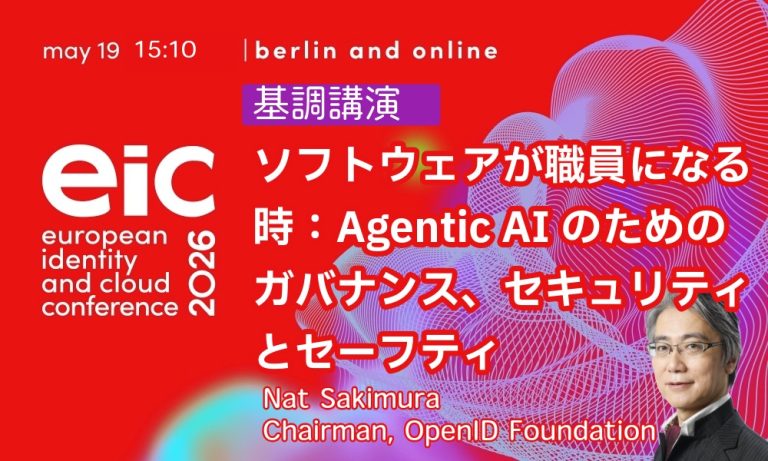
On May 19, I Will Deliver a Keynote at EIC 2026 in Berlin, Titled “When Software Becomes Staff: Governance, Security & Safety for Agentic AI”
On the first day of EIC 2026, I will deliver the keynote “When Software Becomes Staff: Governance, Security & Safety for Agentic AI.”
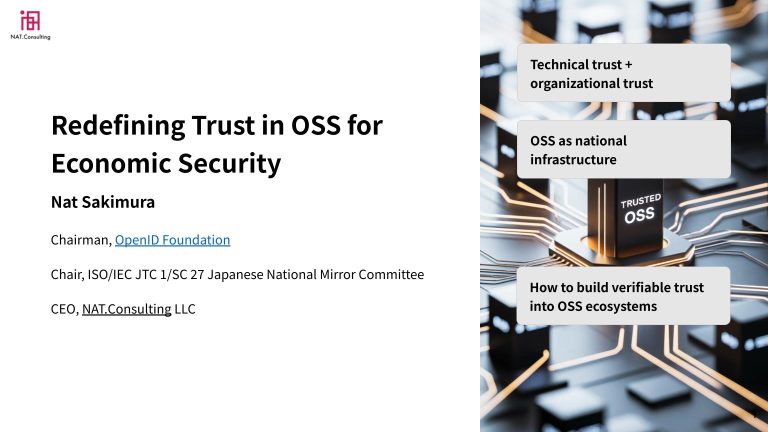
I Will Appear on the Okinawa Open Days Panel “Current and Future OSS Initiatives in Economic Security”
It is already the day of the event—in fact, I am writing this now (12/4 9:45) at my desk while preparing for the panel—but I will…
You must be logged in to post a comment.