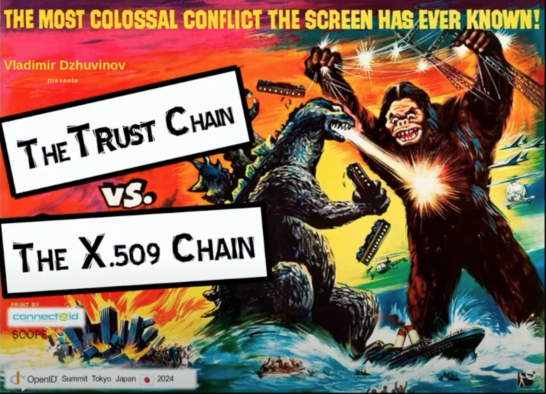
This document summarizes the main themes, key ideas, and facts from the presentation “OpenID Federation 1.0: The Trust Chain vs The x.509 Certificate Chain – OpenID Summit Tokyo 2024.”
Speaker: Vladimir Dzhuvinov
Overall Theme:
A comparison of the Trust Chain introduced by OpenID Federation with the long-established x.509 certificate chain, along with a discussion of the Trust Chain’s benefits and future potential.
Key Points:
- The widespread adoption and history of x.509 certificates: x.509 certificates are embedded widely in credit cards and smartphones and are extremely prevalent. However, this standard was established in 1988, before concepts such as the World Wide Web and APIs emerged.
- “if I reach into my pocket where my credit card is there’s a chip in here and inside this chip there is an x509 certificate so everybody here has one in his uh card and there are probably billions of cards around the world with such certificates inside”
- Factors behind the success of x.509 certificates: The success of x.509 certificates lies in the simple concept of binding a name to a public key and the ability to build a chain up to a trusted certificate authority.
- “what is the certificate it is a very simple binding cryptographic binding between a name this could be the name of a website and a public key and these bindings can be changed all the way up to a trusted certificate Authority”
- The emergence of the OpenID Trust Chain: In federations using OpenID Connect, the Trust Chain was developed to establish trust between OpenID Providers and Relying Parties. The Trust Chain consists of JWTs (JSON Web Tokens).
- Structural similarities between the Trust Chain and x.509 certificates: The Trust Chain has fields similar to those of x.509 certificates, such as issuer, subject, expiration, and constraints.
- Additional Trust Chain capabilities: The Trust Chain can embed metadata, metadata policies, and trust marks. Metadata is used to interact with OpenID Providers, while trust marks provide additional credentials.
- “we have a field which is required for the metadata and the metadata is in there so that we Ed with the open ID Provider by presenting the trust chain then we also have metadata policies now the trust anchor The Authority might want to assert or Define policies in order to make the entities for example uh comply with the puppy profile right and we also have a bunch of embedded jots which can be thought of as accreditations which are called trust marks so they provide an additional Dimension”
- Benefits of the Trust Chain: The Trust Chain can represent more complex trust relationships (such as multilateral federations) and allows trust marks to be inserted. It can also use well-known URLs and Web APIs to build Trust Chains in real time and explore trust-relationship trees.
- “the trust chains enable much more complex trust relationships to be represented things like multilateral federations and they also enable the insertion of stress marks and this is good because it gives security Architects the ability to um to sort of represent and express real world trust relationships”
- A vision of the future in 2035: The speaker envisions a future in which, in 2035, a new version of OAuth 2.0 appears and x.509 certificate chains are replaced by Trust Chains. He describes a future in which the IRS (Internal Revenue Service) becomes a trust anchor, allowing users to access a company’s legal information from the certificate for its website.
- “the IRS then turn intern Revenue Service of the United States has decided to become a trust hker so every company or nonprofit in the states that is registered um Can automatically also enroll its public keys and when it does that what happens the websites when you click on the padlog you can immediately see what the legal entity is behind the website and you can find things like tax tax number”
- The future of the OpenID Foundation: The possibility is suggested that the OpenID Foundation could participate in multiple federations and display trust marks for bank accounts, ISO certifications, carbon neutrality, and completion of survival training.
Conclusion:
The speaker argues that the Trust Chain introduced by OpenID Federation overcomes the limitations of x.509 certificate chains and provides a more flexible and expressive trust model. By integrating with Web APIs, the Trust Chain enables trust relationships to be built in real time, allowing security architects to represent real-world trust relationships more accurately.
Additional Note:
The speaker emphasizes that this content is a prediction of the future and is not definitive information at present.

Related posts
Lithuanian Government Adopts OpenID
It appears that the Lithuanian government has adopted OpenID. According to an email from Arthur Orsevski on the OpenID EU mailing list, after OpenID was introduced…
OpenID Summit Tokyo 2024
The Journey of OpenID Connect over 10 Years and the Future Shaped by Digital Identity The OpenID Connect 1.0 specification was published in 2024, and this…
I Am Running for the OpenID Foundation Board of Directors
This morning, I announced my candidacy for election to the Board of Directors of the US-based OpenID Foundation. The official statement accompanying my candidacy is the…