
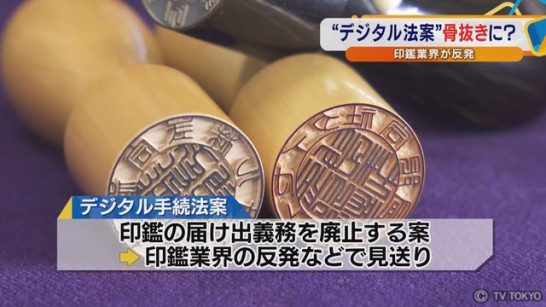
According to TV Tokyo’s Morningsatellite report, “Has the ‘Digital Bill’ Been Gutted? The Seal Industry Pushes Back”, the proposal in the original draft of the “Digital Procedures Bill,” approved by the LDP at a committee meeting on March 7 and aimed at putting 100% administrative procedures online, to abolish the obligation to file seals when establishing a corporation was shelved in response to opposition from the seal industry and others. However, discussion aimed at simplifying seal affixation is expected to resume at the extraordinary Diet session after the summer House of Councillors election.
This is the petition submitted by the printing industry.

🌍️Petition concerning the “Digital Government Implementation Plan”
It says as follows:
The plan appears to contemplate measures that would make seals unnecessary in the following 3 major areas in order to put administrative procedures online. However, as an industry association that manufactures and sells the seals currently used by the people of Japan, we cannot overlook this.
(Source) All Japan Seal Industry Association et al., Petition concerning the “Digital Government Implementation Plan” (2019-02-02)
First, a review of seal affixation for identity verification in administrative procedures (Plan 4.2: Development of systems infrastructure, item 2, Review of methods for identity verification, etc.).
Second, abolition of the obligation to file seals when establishing a corporation (Plan 3.3: Reform of individual services, item 7, Online one-stop processing of corporate establishment procedures).
Third, with regard to seal affixation and paper-based transactions that are customarily carried out between private parties, the government will encourage non-paper digital transactions (Plan 3.2: Cross-cutting service reform, item 2, Promotion of online procedures between private parties).
So, it was the second item that passed and was deleted.1.
I have a few thoughts about this. They concern the relationship between ends and means.
I think filing a seal is the registration of an authenticator/credential for authenticating an entity (a legal person in this case). Since the purpose is entity authentication, any means should be acceptable so long as it is generally available and ensures a sufficient level of security. Security levels also change year by year, so before a means becomes obsolete2, it should be migrated to the next means.
I am no legal expert, but when I asked a legal professional, I was told that “seals (hanko)” are apparently not legally defined. This is excellent. In other words, the law does not define what means “affixing a seal” must involve; it merely provides that “when there is a signature or seal affixation, the document is presumed to have been genuinely established” (Article 228, Paragraph 4 of the Code of Civil Procedure).
This is excellent because it states the objective without prescribing the means. Laws should always be like that. The objective here is to make it possible to presume that a document was genuinely established; what is required of the act of affixing a seal is an act presumed capable of being performed only by its user. It is not limited to attaching pigment from a three-dimensional solid with raised and recessed surfaces to physical media such as paper.3
.
On the other hand, in terms of confirming the intent of a corporation’s representative, registering a means of entity authentication that only that representative can use seems not merely useful but indispensable. I therefore have a proposal.
Just as CRYPTREC publishes its “Recommended Ciphers List for e-Government” after verifying the security of cryptography, how about establishing a “Seal Affixation Method Security Verification Committee” to verify security and interoperability scientifically, creating and publishing a “Certified Seal Affixation Methods List,” and having corporations choose one of the methods on that list when filing a seal?
As you know, the three-dimensional raised-and-recessed objects generally called hanko can now, using modern technology, be reproduced from their seal impressions without the slightest difference. It is therefore difficult to presume that only their user can perform the act. In other words, they have become completely obsolete.4Yet some technological innovation might improve authentication performance. In that case, there is no need to exclude it. I would like members of the Seal Association to compete and develop technology.
Of course, the most appropriate method at the current level of technology is probably a signature based on public-key cryptography. Therefore, as a “seal”5, registering a public key seems most appropriate.6But there is little reason to limit it to that; a newly developed, high-performance seal7could also be acceptable. Therefore, in the discussion that will likely take place at the extraordinary Diet session after the summer House of Councillors election on simplifying seal affixation, I would very much like the arrangements to proceed in a direction under which corporations register a seal by selecting from methods included in the “Certified Seal Affixation Methods List” created by the “Seal Affixation Method Security Verification Committee.”
Incidentally, the above Petition concerning the “Digital Government Implementation Plan” is quite an amusing document. The entire text invites retorts, but especially the following:
Unlike Western signature systems, we take pride in the fact that the distinctive feature of seals—the ability to make proxy settlements—leads to rapid decision-making and approval, and has contributed to Japan’s rapid postwar development.
(Source) All Japan Seal Industry Association et al., Petition concerning the “Digital Government Implementation Plan” (2019-02-02)
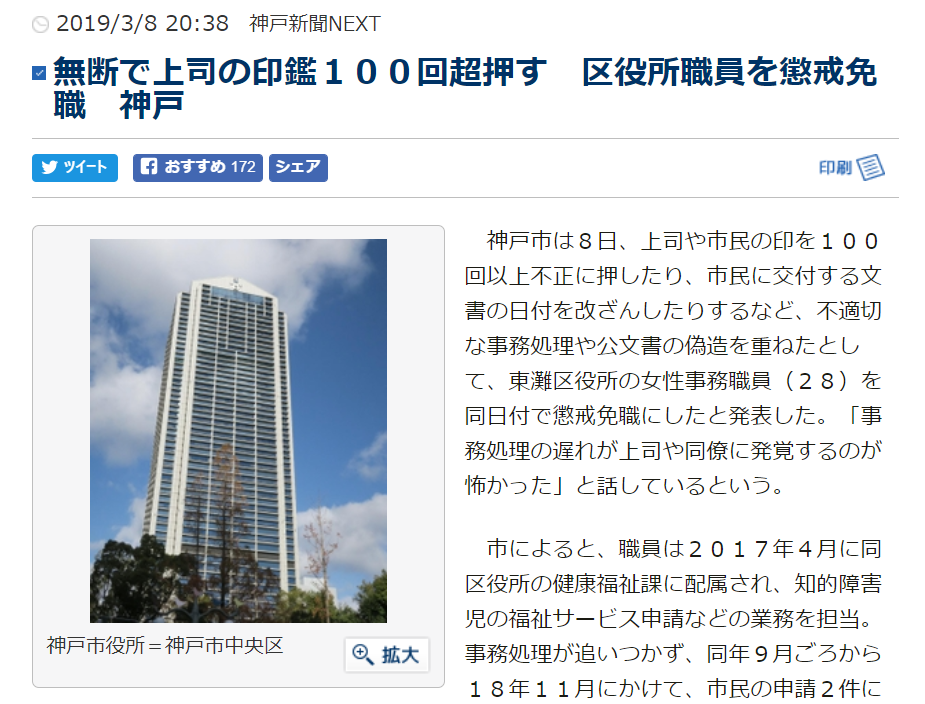
The passage above is not merely a mistake in an official document of writing “settlement” (決済) where “approval” (決裁) was intended, and failing to notice it; it is, in effect, suicidal wording. For why, see Sign Re-Design’s article8. Timely news that illustrates the point came in, so I will leave it at that.
And that is all.
Footnotes
- I find it very hard to understand why this is so readily deleted while criminalizing downloads is not.
- something that was once safe but becomes dangerous and unusable through technological advances or other developments.
- According to someone who investigated this matter, “In fact, seals appear quite often in procedural laws. A search of H29.9 statutes finds a mixture of seal certificates (32), registered seals (133), seal impressions (34), seal affixation (590), and stamping (14). (Seal stamping (0).) But they do not say what must be stamped.”
- Previously, copying technology was immature, so a certain degree of security could be ensured; but technological innovation made them dangerous, so this is precisely obsolescence.
- the name or picture left when a seal is affixed to paper or a document; a seal impression.
- It need not be a certificate issued by a so-called certification authority. A public key generated by oneself would suffice. The act of filing a seal is itself registration, and verification can be performed using that registry.
- for example, a hanko with a high-performance clock that dynamically creates a super-high-resolution seal impression, where the impression encodes a QR code of a public-key signature over a string combining the input document number and the time obtained from the clock, rendered in gray and vermilion of the same brightness, with the vermilion portions forming the characters of the name.
- Sign Re-Design, “Is the distinctive feature of seals—that they permit proxy settlement—legally recognized?” (2019-03-09) https://www.cloudsign.jp/media/20190309-syomeidairi/
Related posts

IPA’s Mr. Tsuda Receives FORBES Japan’s “30 Under 30” Award
Mr. Tsuda of IPA, whom I think is one of the ID geeks, has been selected for FOEBES JAPAN 30Under30 2026. He is the second member…
OpenID Summit Tokyo 2026 “Special Edition” Closing Keynote
The tickets apparently sold out instantly, so I had not introduced this event here; however, tomorrow, August 26, I will appear at the OpenID Summit Tokyo…
Data Sustains Lives—MyDataConference 2026 Opening Address
The following is the opening address for the MyData Japan Conference 2026, delivered by Nat Sakimura in his capacity as Chair of the General Incorporated Association…
You must be logged in to post a comment.