
Today from 10 a.m., on the 10th floor of the Ministry of Internal Affairs and Communications in Conference Room 1, the “Study Group on Platform Services (6th Meeting)” was held with State Minister for Internal Affairs and Communications Yukari Sato in attendance. Following opening remarks by State Minister Sato1, the secretariat explained the 46-page “Interim Report (Draft),” after which an exchange of views took place.
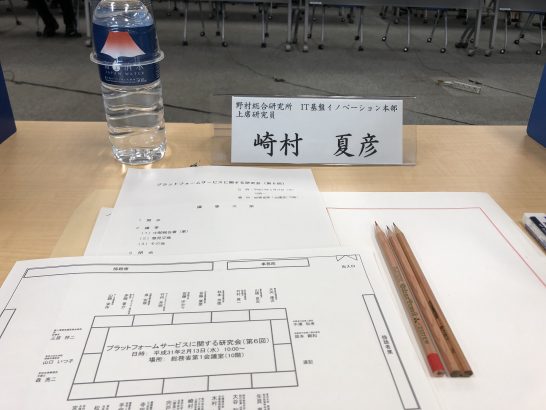
I had already read through the draft report distributed to members yesterday and knew it was an impressive piece of work, so I initially planned to devote myself to being a mere ornament. Before the meeting, however, I posted “Today’s ornament duty” on Facebook. As soon as Chair Shishido saw me enter the room, he instructed me to “do some real work instead of being an ornament.” Inspired as well by the observations of the other members, I ultimately made the following remarks.
(Summary of Sakimura’s remarks)
- Thank you for compiling such an excellent report. I have roughly 4 points for future consideration.
(1) Availability
- It is very good that Availability includes the point that services must be “easy for users to access” (easy to use).
- At the same time, places where they can be used must be secured.
(2) The Nature of Consent
- Easy-to-understand consent is important.
- On the other hand, “consent fatigue” is a serious problem.
- Hiding consent with a major privacy impact among numerous consents with no privacy impact, like hiding a tree in a forest, is a classic attack on privacy. Moving toward demanding consent at every turn, as in the EU, makes such attacks easier.
- In this regard, it might be effective for Japan to take the lead by considering, for example, institutionalizing consent through representatives or agents from a consumer-protection perspective.
(3) Portability (p. 15)
- Unless the formats for data and the protocols for exchanging it are standardized internationally, portability risks becoming merely an empty promise with no practical effect. This must be considered as well.
(4) Fake News
- Regarding the policing of fake news, attention must be paid to asymmetries in power between companies and individuals, and between speakers and those demanding removal. Even on YouTube, uploading something immediately draws a copyright objection. Many are improper objections, and of course I contest them and have them withdrawn. But the process may have to be conducted in English, and failure may risk deletion of the consumer’s account. An ordinary consumer or citizen would hardly feel able to fight back. If a similar system is adopted, it could be used to suppress citizens’ speech. Institutional arrangements that are friendly to consumers and citizens are desirable.
(End of summary of Sakimura’s remarks)
In the motion following the discussion,
- Chair Shishido was entrusted with revising the Interim Report (Draft) in response to members’ comments
- A public comment period would be held from 2/18 through 3/8
were resolved.
Incidentally, today’s meeting appears to have been broadcast on TBS under the title “Secrecy of Communications Regulations for GAFA as Well.”
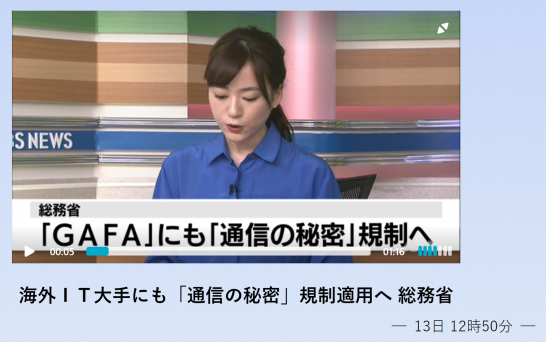
If I remember correctly, I do not think the report used the term “GAFA,” but never mind. If you watch the video to the end, you will see an extreme close-up of me.
·
·
·
My name badge, lol.
Footnotes
- TBS television cameras filmed through this portion. For the broadcast, see “MIC to Apply Secrecy of Communications Regulations to Major Overseas IT Companies”.
- chaired by member Tezuka
Related posts
Anyone Who Thinks Identity Is Given by the State or Government Should Sit Up and Read This: Utah Digital ID Bill SB260 and the Transformation Brought by a User-Centric Digital ID System
As digital technology evolves, our dependence on personal information and data continues to grow. Yet many government-provided ID systems do not always give sufficient consideration to…
Digital Agency: Expert Meeting on Organizing Issues Concerning Attribute Credentials (1st Meeting)
This is slightly old news, but on October 23 I participated remotely as a member in the Digital Agency's “Expert Meeting on Organizing Issues Concerning Attribute…
The “DS-511 Guidelines for Handling Digital Identity in Identity Verification for Administrative Procedures, etc.” Have Been Published
After 3 years of development, the Digital Identity Guidelines, to which I had the privilege of contributing as an expert (Expert Meeting on the Revision of…
You must be logged in to post a comment.