
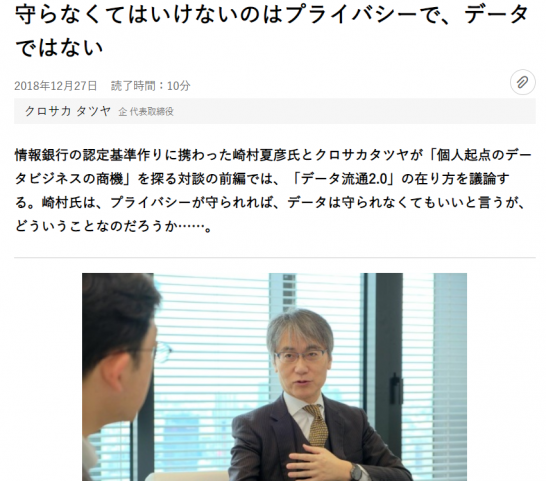
Two interview articles were published in Nikkei X-Trend.
The titles are sensational, but that is not my fault!
This prompted a variety of comments. They ranged from the welcome comment by Professor Shishido of the University of Tokyo, “This truly is the definitive, highly substantial account,” 1 to the opinion that “the ‘information bank’ discussed here lacks ‘data portability,’ so isn’t it something different?”
To begin with, what did the term “information bank” mean when it first appeared?
(The following will be revised as needed as various information continues to come in.)
As far as my searches show, the earliest appearance of the “information bank” seems to be around JIPDEC’s Information Bank Study Group in 2011. The earliest instance appears to be the “Near-Future Value Chain Study Group” (JIPDEC) in fiscal 20092. Thank you to Naoyuki Ito for pointing this out. Naturally, it is connected with Professor Shibasaki. Before that, the examples of “information bank” all appear in a different context34
Here, the objective of the Information Bank TF is stated as follows:
Propose the concept of an “information bank,” an institution that holds and appropriately manages information in the same way that a bank holds and manages money, and discuss the establishment of information banks. Specifically, the aim is to utilize various sensors distributed throughout living spaces (in cities, automobiles, etc.), accumulate and use the information collected, and create new services.
(Source) JIPDEC, “Near-Future Value Chain Infrastructure Development WG Activity Report 2009,” p. 3
Specific matters for consideration:
✔ Technologies and methods for collecting information
✔ Rules for collecting information and required criteria and standards, etc.
That is the stated objective.
Later, JIPDEC also held an Information Bank Study Group in fiscal 2011, and I think I probably first heard about it at a JIPDEC advisory meeting at the time5. In 2012, Professor Shibasaki also gave a TEDx talk6.
Professor Shibasaki specializes in spatial information science, so the initial approach seems to have come from that direction. His concerns were as follows:
- Although users’ last-known location information from the Great East Japan Earthquake should have remained with mobile phone companies, it could not be used to search for missing relatives because it was covered by the secrecy of communications.
- Something must be done about the problem of data existing but being entirely unusable.
- To that end, people should fundamentally manage their own personal information and be able to use it for themselves. The “information bank” is being tried as a mechanism for this.
- An “information bank” is a mechanism that lets individuals deposit their information into their own accounts at the information bank and use it for themselves.
- On the other hand, when rescuers need to know how many people are stranded in various places, as during a disaster, the information bank can provide only the number of people without compromising privacy.
- Like a bank that handles money, it can ensure that information one has deposited is securely protected while enabling that information to contribute to society in various ways.
Those are the kinds of things he said7.
Furthermore, an Information Bank Consortium was organized in 20138. Following that, at the JICS Closing Panel in 2014, we addressed information banks under the title “Can Information Banks and PDS Become High-Performance Sports Cars for Utilizing Personal Data?”
9. I was the moderator, and Professor Sunahara and Yoshihiro Sato were the panelists.
Before that, in the context around me, the terms were PDV (Personal Data Vault), PDS (Personal Data Store), or PDE (Personal Data Ecosystem). The latter two were concepts that emerged at IIW, probably. They had appeared by 2010 at the latest, and slides by Identity Woman and Markus are available on SlideShare10.
Meanwhile, PDV appears in the 2009 paper “Designing the Personal Data Stream: Enabling Participatory Privacy in Mobile Personal Sensing” 11.
Another related concept that emerged around IIW 12 was Doc Searls’s VRM. So when the “information bank” appeared, I remember that my greatest concern was, “What will happen with interoperability with PDS and PDE?” Well, neither PDS nor PDE defined a protocol, so they did not work out. Incidentally, it was at the IdCon Satellite on June 26, 2013 (Wednesday) that I told Thomas Hardjono, then director of MIT-KIT’s OpenPDS, “It cannot be a Store (warehouse). It has to be a Service.” 13. Looking now, Wikipedia has also changed to “Service” at some point.
The first person to promote ideas and protocols that could be used in this area may have been Eve Maler, then at Sun Microsystems, around 2008. This is what is now called UMA (User Managed Access)14. Its roots may be in the Liberty Alliance’s ID-WSF. Thomas was also one of the key people promoting it alongside her. I remember being called over after a Liberty meeting held at the Sun Microsystems campus and hearing the idea for UMA, so it must have been in 2008.
UMA has a good philosophy, but it has not gained adoption because it violates the KISS principle. I support it morally and review it too (though often at the last minute), but I have continually submitted negative comments15, so I imagine Eve thinks, “Then show me an alternative proposal”…
Now, regarding “data portability,” it requires a machine-readable, standardized schema and a protocol for transferring it. Without those, it is merely information disclosure. There is no doubt that UMA comes close in terms of the protocol. However, UMA does not provide a schema, so a schema must be created. At present, the only ones available seem to be Open Banking16 and FHIR17. That is why the current certification criteria18 stop at “disclosure.” If data portability were required, it would be impossible to implement outside finance and healthcare, and moreover, those fields are out of scope under the “MIC and METI Guidelines ver. 1.” Certification criteria that no one can satisfy are meaningless.
In that sense, I believe international standardization of schemas is needed as quickly as possible. I hope those seeking to commercialize this area will be sure to allocate budget for that work.
Footnotes
- Viewable only by Professor Shishido’s FB Friends: https://www.facebook.com/george.shishido.3/posts/2021258367956511
- https://www.jipdec.or.jp/archives/publications/J0004286
- As I also learned from a point made by Ito, Sony filed a patent concerning an information bank.
https://www.j-platpat.inpit.go.jp/web/PU/JPB_4524848/1FFAB0FB9AF1172BDE2504BD31A68728. This appears to be a model in which the information bank holds the data but does not provide the data to service providers. - Ito also pointed out that in 2009, Senior Researcher Nakata of MRI proposed a “personal information bank” in the context of an electronic post office box.https://www.mri.co.jp/NEWS/magazine/club/05/__icsFiles/afieldfile/2009/02/02/20081101_club03.pdf?fbclid=IwAR3QicfW4XdmXBZStypLRELsyP7obd6zncPHO9B5RIXLNQwUtyzHMg8k1J8
- JIPDEC Business Report https://www.jipdec.or.jp/…/u71kba0000000…/h23_hokoku.pdf
-
https://www.tedxtokyo.com/tedxtokyo_talk/information-bank/ - Anagura no Uta, “Technology for Obtaining Information from Space” https://www.miraikan.jst.go.jp/sp/anagura/interview1.html
- @IT, “The Era of Creating Value from Personal Information: Toward Establishing the ‘Information Bank Consortium’—From Big Data to the Deep Data Era”http://www.atmarkit.co.jp/ait/articles/1310/02/news133.html
- https://www.sakimura.org/2014/01/2169/
- https://www.slideshare.net/Kaliya/personal-data-store-project-4782433
- https://scholarworks.umass.edu/cgi/viewcontent.cgi?referer=https://www.google.com/&httpsredir=1&article=1356&context=esence
- some of it may have been at Internet Identity World.
- https://idcon.doorkeeper.jp/events/4153
- https://kantarainitiative.org/confluence/display/uma/Home
- the main point being, “It is too complex. There is no migration roadmap from something simple to something more complex.”
- https://openbanking.atlassian.net/wiki/spaces/DZ/overview
- http://hl7.org/fhir/
- https://www.tpdms.jp/
Related posts
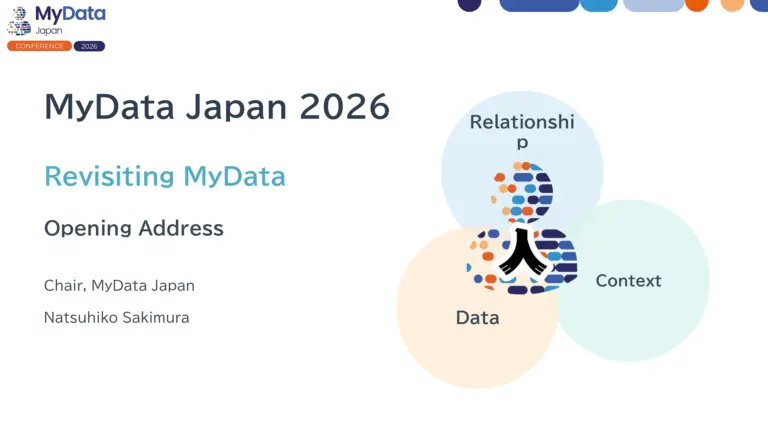
Data Sustains Lives—MyDataConference 2026 Opening Address
The following is the opening address for the MyData Japan Conference 2026, delivered by Nat Sakimura in his capacity as Chair of the General Incorporated Association…
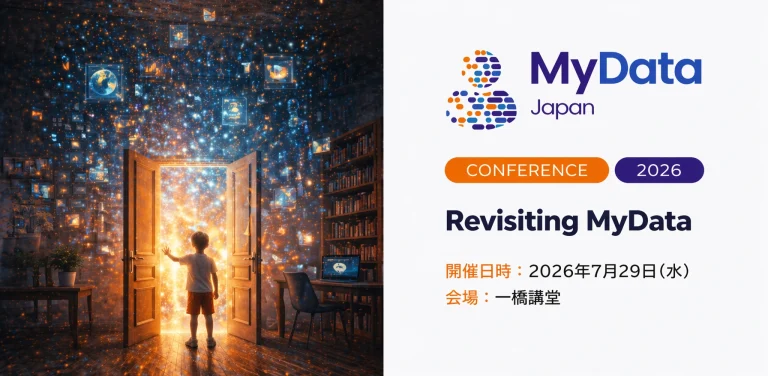
The MyData Conference 2026 Is This Wednesday. See You at Hitotsubashi Hall!
I have been posting announcements on X every few days, and the MyDataJapan Conference 2026 is this Wednesday. There are many highlights: Naohiro Fujie, Representative Director…
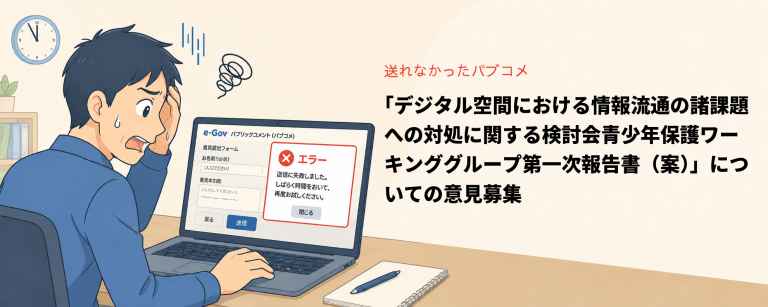
Unsubmitted Public Comment on the Call for Comments on the Draft First Report of the Youth Protection Working Group on Information Distribution in the Digital Space
July 823:59 was the deadline for the call for comments on the draft first report. I ended the FAPI WG early and23:40 began the submission process…