

“Sonata quasi una fantasia” (a sonata in the manner of a fantasy)1, commonly known as the “Moonlight Sonata” (op.27, No.2) 2, is probably one of the most frequently performed of Beethoven’s many sonatas.
At its opening, Beethoven included 2 performance directions that determine the character of the piece. They are the instruction shown in Figure 1, “Si deve sonare tutto questo pezzo delicatissimamente e senza sordini” (“The whole piece must sound with the utmost delicacy and without dampers”)3, and, as if to reinforce it further, the instruction written within the staff: “sempre pianissimo e senza sordini” (“pianissimo throughout and without dampers”)4.

To understand these directions, we must understand the construction of the piano Beethoven had in mind.
Let us first explain the easier of the two: what “sempre pianissimo e senza sordini” (“pianissimo throughout and without dampers”) means.
The Anton Walter5 pianoforte used by Beethoven was equipped with a moderator. Many upright pianos today still have a mechanism that inserts a piece of felt between the hammers and strings. That is what this was. Piano hammers at the time were made of leather and produced a relatively hard sound, but using this “moderator” made it possible to produce the softer sound created by felt. Beethoven’s instruction “sempre pianissimo e senza sordini” (“pianissimo throughout and without dampers”) appears to be an instruction to use this moderator.
Next comes “Si deve sonare tutto questo pezzo delicatissimamente e senza sordini” (“The whole piece must sound with the utmost delicacy and without dampers”).
When this piece was written, pianos were in a transitional period: damper operation was shifting from a hand stop, in which a lever was pulled by hand to raise the dampers (Figure 2)6, to a mechanism that raised the dampers with the knee (Figure 3)7.
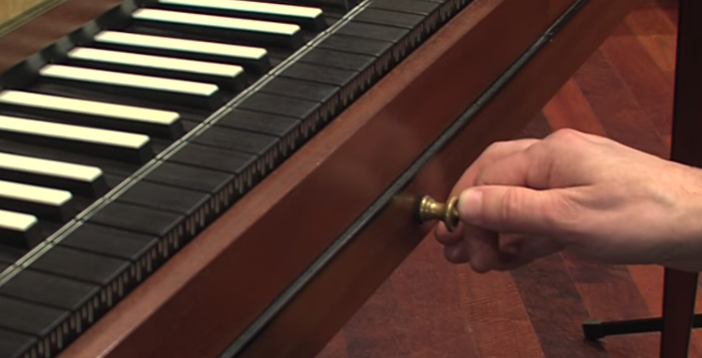
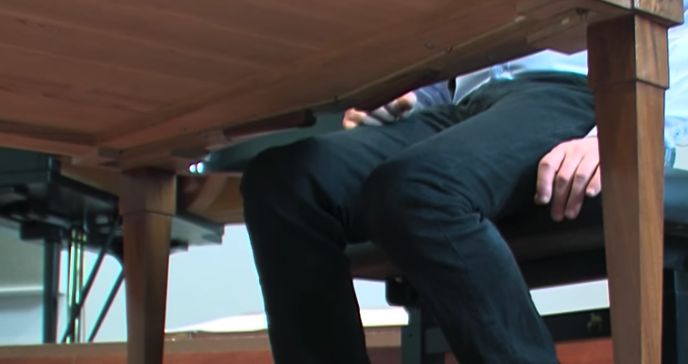
The A. Walter pianoforte used by Beethoven had such a “knee pedal,” but here Beethoven is asking the performer to keep the dampers raised continuously, as on an “old-fashioned” pianoforte8.
Another name for this “hand stop” is the “Celestial Stop,” about which C.P.E. Bach wrote in 1762 that “if one knows how to manage the lingering resonance skillfully, it produces a most pleasing effect in fantastic improvisations.”9. This is precisely the effect Beethoven sought. We can also see this from the comment made by Beethoven’s secretary Anton Schindler when he published a revised edition of his Beethoven biography in the 1850s: “Modern pianos resonate for too long, so this instruction by Beethoven is inappropriate.” This naturally applies to modern pianos such as Steinways as well. Because the sound becomes muddy, the pedal must be changed with every chord. Doing so emphasizes the bass melody, however, creating a slight divergence from the music Beethoven intended.
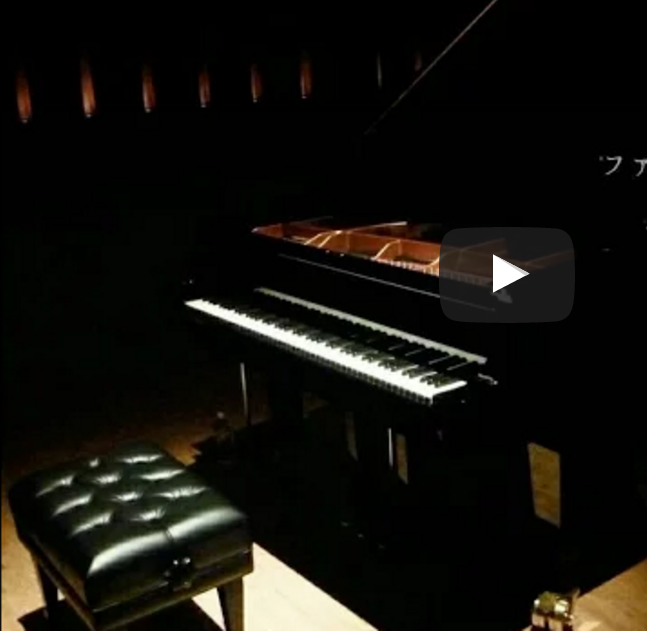
This is what it sounds like when played on an A. Walter piano with the dampers kept raised, exactly as Beethoven instructed.

What a beautiful sound, as though drifting through mist. I would very much like to hear the whole piece performed by Tom Beghin, who introduced this to us, but it does not appear to be available on Youtube. What a shame.
How Should It Be Played on a Modern Piano?
With all this in mind, how should it be played on a modern piano?
It would probably be played by making full use of half-pedaling. According to András Schiff, about 1/3 is best10. In fact, there is an outstanding performance with precisely that kind of sound: Friedrich Gulda’s Decca recording from December 195711. It was part of a complete recording made when he was only 27 years old, and this piece was recorded at Kingsway Hall in London. Please give it a listen.

Footnotes
- More precisely, “Sonata quasi una fantasia per il Clavicembalo o Piano Forte” (a sonata in the manner of a fantasy for keyboard harpsichord or pianoforte)
- First edition — http://conquest.imslp.info/files/imglnks/usimg/3/33/IMSLP51038-PMLP01458-Op.27-2.pdf
- (English translation)The whole piece must sound most delicately and without damper
- (English translation)Simply pianissimo and without dumper
- The leading Viennese piano maker of the time. He introduced numerous innovations, including not only knee levers but also heavier hammers, a mechanism preventing hammers from rebounding when a key was released, and the use of 3 strings in the upper register, and produced roughly 1000 pianos.
- https://www.youtube.com/watch?v=LJuNgjb2HcY
- https://www.youtube.com/watch?v=LJuNgjb2HcY
- It is said that the A. Walter piano used by Mozart also employed a hand stop. The surviving instrument was subsequently modified by A. Walter to add a knee pedal.
- The introduction of such a mechanism is thought to have begun with the attempt to combine two instruments in a single case: the “pianoforte” with the dampers lowered, and the “pantalon,” represented by the dampers being raised. The latter was a very popular instrument at the time, belonging to the zither family with a resonating box, whose strings were struck with beaters to produce sound. The modern cimbalom is similar. At the time, the word harpsichord referred to an instrument of this kind, and one fitted with a keyboard was the “Klavicembalo” (keyboard harpsichord) included in the title of the piece. (Source) Tom Beghin: Beethoven’s “Mondschein” Sonata, Opus 27 No. 2 and the Undamped Register <https://www.youtube.com/watch?v=LJuNgjb2HcY> and the author
- https://youtu.be/H6u9Ocp039Y?si=tt6vqTNuc025U40H&t=450
- The edition recommended by Hidekazu Yoshida. I recommend it too.
Related posts
C.P.E. Bach, Father of Classical Music: 300th Anniversary of His Birth
Ah, I have given it another sensational title. Nevertheless, I do not think it is entirely wrong to call C.P.E. Bach (Carl Philipp Emanuel Bach), whose…
On the 230th Anniversary of Kuhlau’s Birth
I seem to have an affinity for composers who remain in the historical record but are relatively obscure. While sorting through a pile of scores at…
Variations on a Theme of FamilyMart for Woodwind Quartet and Piano
This was today's big find. The video was uploaded on 2016/1/25, and in 5 days it has been viewed nearly 150,000 times . It is a…
You must be logged in to post a comment.