
There are not as many original works for flute as there are for violin or piano, but masterpieces can be hidden in unexpected places.
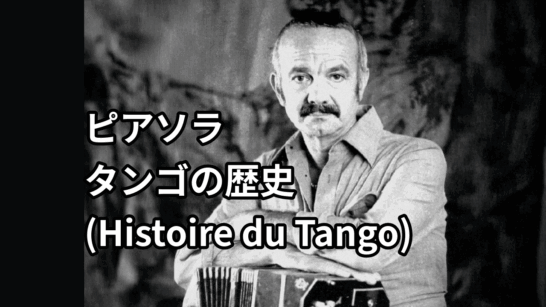
Do you know the composer Astor Piazzolla (1921 – 92)? Yes, he was a composer of the 20th century who wrote a great many tangos. Having studied under Nadia Boulanger at the Fontainebleau Conservatory, he worked tirelessly to elevate tango into a form that could be performed in concert halls.
Piazzolla received a government scholarship and left his 2 children1 with his parents when he went to study with Boulanger in Paris in 1954, at the age of 33. By then he had grown weary of bandoneon tango and, believing that classical music was his true path, apparently showed Boulanger works inspired by classical music. Boulanger finally approved, however, only when Piazzolla played “Triunfal (Triumph).” She pointed out that his talent lay precisely in tango. This became the historic encounter between classical music and tango.

Under Boulanger, Piazzolla learned counterpoint and other classical techniques. Performing with the Paris Opera orchestra, he established his style of playing the bandoneon while standing with one foot on a chair2 Around this time he also encountered the jazz octet, inspiring him to form his own octet after returning to Buenos Aires. This octet marked the birth of chamber music in the tango world.
These innovations, however, were not appreciated by Argentina’s conservatives. He subsequently began a life of moving between Buenos Aires and locations around the world, beginning with a move to New York. He produced many works, including the opera “María de Buenos Aires,” but suffered a heart attack in 1973. That year he moved to Rome, where Aldo Pagani gave him a 15-year contract to record all the music he had written and would write. This period produced such masterpieces as “Libertango.”
It was not until 1980, when he was 59, that he earned enough income to write the music he wanted for the first time in his life. That year he began writing ambitious multi-movement works. One of those 1 works was “Histoire du Tango.” Dedicated to the flutist Marc Grauwels and premiered by him with guitarist Guy Lukowski3, it is a work for flute and guitar in 4 movements, depicting tango’s evolution at intervals of 30 years from one movement to the next. Piazzolla himself supplied program notes4.
Movement 1: 1900: Bordello (Bordello, 1900)
Tango was born in Buenos Aires in 1882. At first it was played on flute and guitar. The piano was soon added, and later the concertina joined the ensemble. The music is full of grace and vitality. It depicts the cheerful chatter of French, Italian, and Spanish prostitutes gathered at a bordello as they tease the policemen, thieves, sailors, and good-for-nothings who come to see them. It is a bright, buoyant tango.
— Astore Piazzolla5
Argentina in the 1900s was one of the world’s leading economic powers and was extremely wealthy. In 1913, its per-capita national income ranked 10th in the world. Japan’s figure at the time was US$1387, while Argentina’s exceeded US$5900 (back-calculated from data showing that Argentina’s per-capita GDP was 3/4 that of the United States). In 2015, Japan ranked 26th. This prosperity drew people from many countries.6
According to Marc Grauwels, the flutist at the premiere, the 4th note of the opening phrase (the high E) represents the whistle of a policeman raiding the bordello. (In his recording, he actually holds this E.)
A major. Molto giocoso. It suggests something highly playful, fun, and cheerful—exactly the women joking, teasing their customers, and chatting merrily. The articulation is specified in extraordinary detail and in a fairly irregular manner.
This may not be the orthodox interpretation, but to me this movement looks like a neoclassical allegro-sonata form learned from Nadia Boulanger. The 1st and 2nd themes, however, are both presented in the same key of A major. Perhaps this is an homage to the simple music of the tango players of 1900, who could not even read notation. In other words, it is a deliberately constructed modified sonata form.
Viewed as sonata form, it can be outlined as follows.
| Section | Measures | Role in sonata form | Characteristics and key |
|---|---|---|---|
| Exposition | 1 – 32 | 1st theme + transition (bridge) | A major. “Molto giocoso.” Playful leaps in 16th notes. |
| 33 – 47 | 2nd theme | A major. The character of the rhythm and song changes. | |
| Development | 48 – 60 | Development (first half: fusion of motifs) | Motifs from the 1st and 2nd themes intertwine polyphonically. |
| 61 – 105 | Development (second half: parallel-minor development) | Modulates to A minor. Earthiness, melancholy, and urgency increase. | |
| Recapitulation | 106 – 112 + 8 – 47 | Recapitulation | Returns to A major. The 2 themes return and rush to the finish. As in classical sonata form, both 2 themes are played in the tonic key. |
The development beginning at measure 48 is the very model of an orthodox development section using “counterpoint” and motivic development learned from Nadia Boulanger. It is moving that Piazzolla, who had wanted to write classical music, wrote in sonata form as soon as he was finally in a position to compose as he pleased.
Movement 2: 1930: Café (Café, 1930)
In 1930, people stopped dancing as they had in 1900 and preferred simply to listen. Tango became more musical and more romantic. It underwent a complete transformation. The tempo slowed and acquired new harmonies, often tinged with melancholy. Tango orchestras of the period consisted of 2 violins, 2 bandoneons, piano, and bass, sometimes with a singer as well.
— Astore Piazzolla7
Portraying tango after it ceased to be dance music and became music for listening, Piazzolla filled this movement with slow, novel, melancholic harmonies. It begins in E minor, the dominant key of the first movement.
Movement 2 can broadly be organized as follows.
| Section | Role | Characteristics |
|---|---|---|
| Introduction | Presentation of the harmonic world | Guitar arpeggios. An F with the quality of a flat 9 clashes against the central E. |
| Part 1 | Presentation and development of the main melody | Molto espressivo flute. A descending, sighing melody. |
| Developmental rise | Transformation of the main melodic material | Molto cantabile. It gradually grows urgent and contrapuntally denser. |
| Middle section | Parallel-key, retrospective episode | E-major brightness, but marked tristemente. |
| Return of part 1 | Restatement of the opening world | Returns to E minor and restores the opening harmony and melody. |
| Coda | Dissolution | Chromaticism, diminuendo, and rallentando make it fade darkly away. |
This movement is not in sonata form like movement 1. Rather, it resembles a romantic ternary form / expanded song form.
The opening direction is Ad lib. (Romantico). This is very important.
Movement 1 was Molto giocoso, with a clear character and dance-like momentum. In movement 2, freedom of tempo, rubato, and the breathing of the melody suddenly come to the fore.
At this point, tango has become music not for dancers but for listeners.
The opening of movement 2 is no longer a dance step. It begins as though the guitar’s harmony were slowly rising into the atmosphere of a café.
Introduction: opening harmony: F clashes above Em
The introduction begins with F, a semitone above the root E, sounding simultaneously as a flat 9 tension in an Em(flat 9/add13) chord. This decadent, languid, melancholic dissonance suits a café of the 1930s. Piazzolla opens the work by presenting this chord as a rising arpeggio. As his notes say, “the tempo became slower and was accompanied by new, often melancholy harmonies”; this symbolic chord work brings classical techniques associated with Debussy and Ravel into traditional tango.
Part 1: melody built through motivic development of two contrasting motifs
The 1st theme, marked molto espressivo and then played by the flute, is introduced as a countermelody above this introduction. Its highly structured design continuously combines and develops a first, scalar motif that descends from the tonic in a long note plus 2 short notes, moving 2 degree at a time over 9 degrees (with a detour at notes 8–10), and a second, arpeggiated motif of 8 3th notes descending by 4 and 3 degrees, rising 5 degrees, and ending in a 2th note. The somewhat intense molto cantabile, which serves as a development, is likewise built from a developed form of motif 2, a stretto diminution of motif 1, and their development and variation. This is motivic development within the melody itself. It gradually accelerates, increasing urgency toward climax 1, introduces counterpoint, then slows with rall., resolves from the minor subdominant to the tonic, and restates the first theme. Part one ends with a cadenza-like guitar gesture.
Middle section: a Tempo tristemente: a recollection filled with sorrow
The middle section, which begins by shifting from E minor to its parallel key of E major, is marked “a Tempo tristemente,” or “at a sorrowful tempo.” The brightness of the E-major flute melody seems to recall happy days gone by, and therefore deepens the sorrow still further, until the recollection is cut off by a crescendo in the guitar chords. A guitar cannot crescendo within a single chord, but Piazzolla’s own notes describe the tango band of the time as violins x2, bandoneons x2, etc., so in his mind the bandoneon must surely have been making the crescendo. Part 2 then severs the sweet recollection with a rising arpeggio on B7(flat 9/no3), “the ultimate sharpened dominant-tension chord” in the home key of E minor, and brings us back to reality by resolving into the Em of the returning 1st theme.
Return of part 1 and coda: a conclusion that vanishes into darkness
The returning 1st theme eventually passes into a coda characterized by chromaticism, and the piece closes pianissimo, seeming to disappear into darkness through diminuendo and rallentando.
Whereas movement 1 ends cheerfully, movement 2 ends by fading away. This ending also shows tango’s transformation from an outward-looking dance into inward music for listening.
Movement 3: 1960: Nightclub (Nightclub, 1960)
1960: This was an era when international exchange expanded rapidly. Brazil and Argentina met in Buenos Aires, and tango evolved once again. Bossa nova and the new tango beat the same rhythm. Audiences flocked to nightclubs and listened intently to the new tango. This was the moment that brought revolution and profound transformation to some of tango’s original forms.
— Astore Piazzolla8
During the 1960s, international movement of people increased tremendously. Tango too entered a period of major transformation when Brazil and Argentina met in Buenos Aires and bossa nova and nuevo tango began to share the same rhythm. Audiences crowded into nightclubs to hear the new tango. This period can be called an age of tango revolution, when modern tango diverged greatly from its original form. The key is A minor and the marking is Deciso, ♩=120. Its character is “resolute” and “clear.” Yet this is not simply a fast movement: it has a composite structure combining fast Deciso passages, slow cantabile passages, and percussive flute techniques.
This movement can broadly be viewed as the following multipart form.
| Measures | Section | Marking and characteristics | Function |
|---|---|---|---|
| 1–17 | A | Deciso / accentuato | Main section. Presentation through short rhythmic motifs. |
| 18–25 | A’ | Deciso | Transformation and expansion of the main section. |
| 26–35 | B | Lento, molto cantabile / rubato | Songfulness and introspection recalling movement 2. The tempo relaxes. |
| 36–43 | C | Pesante (a T°) tristemente | A heavy, sorrowful episode. |
| 44–53 | D | a Tempo lentamente (cantabile) | A retrospective song. |
| 54–59 | E | Tempo I / T and K notation | Percussive flute section. |
| 60–84 | F | Fast development, legno / frullato | Chromaticism, timbral effects, and increasing tension. |
| 85–107 | G | Lento Finale | A quiet, reflective passage. |
| 108–128 | A’’ | Tempo I, molto deciso | Return and conclusion of the Deciso main section. |
A (1–17): Deciso main section
The opening begins with a rhythm including the guitar’s bass, and the flute enters accentuato at measure 2. The flute material presented here is not a long, singing melody but a short rhythmic cell.
Its characteristics are as follows.
| Element | Content |
|---|---|
| Rhythm | Syncopation, short rests, sharp accents. |
| Melody | Short ascending and descending figures are repeated and transformed. |
| Tonality | Centered around A minor, but with G-sharp, F-sharp, C-sharp, and other notes, so it is not a simple natural minor scale. |
| Guitar | Combines bass and chords and functions like a rhythm section. |
Tango’s dance character remains here, but this is not simple dance music like movement 1. The sound is hard and incisive, and the rhythm is more nervous. Rather than nightclub glamour, this tango has a sense of urban tension.
Movement 1 centered on 16th notes resembling “playful conversation”; in movement 3, even similar short figures are more angular and strongly accented, closer to Piazzolla’s own Nuevo Tango idiom.
A’ (18–25): expansion of Deciso
At measure 18 the music is marked Deciso again, continuing and expanding the character of the opening main section.
The exchange between flute and guitar intensifies; the guitar not only repeats the bass but also supplies inner-voice motion and chordal responses. The flute figures remain short, but extend slightly more melodically than in measures 1–17.
Around measures 24–25, a rall. temporarily slows the fast main section, bridging into the following Lento. Measures 1–25 (A+A’) can therefore be viewed as one large main section.
B (26–35): Lento, molto cantabile
At measure 26 it becomes Lento (molto cantabile). The music’s sense of time changes greatly here.
The Deciso main section centered on short figures and rhythm, but here the flute sings at length. There is rubato in measure 29 and rall. from measure 32 onward, releasing the rigidity of the meter.
This passage recalls the romantic language of movement 2, “Café 1930.” It does not sink as deeply into decadence and melancholy as movement 2, however, but is inserted like a briefer recollection.
Its function is not merely that of a middle section, but of a song that suddenly appears amid the clamor of the nightclub. This is a common Piazzolla design: a solitary melody emerging within an extroverted rhythm.
C (36–43): Pesante (a T°) tristemente
From measure 36 comes Pesante (a T°) tristemente: heavy (at the original tempo) and sorrowful. Its character becomes still heavier and more subdued than the cantabile of section B.
Musically, tango’s sorrow now comes to the fore. After the hard Deciso of measures 1–25 and the songfulness of measures 26–35, measures 36–43 reveal a heavy, sunken expression: the shadows behind the nightclub’s glamour.
D (44–53): a Tempo lentamente (cantabile)
From measure 44 comes a Tempo lentamente (cantabile). The singing character continues, but the mood is calmer and more reflective than the Lento at measure 26.
The guitar maintains a relatively regular accompaniment pattern while the flute plays a longer melody. The Café-like element of movement 2 seems to enter movement 3 like a shadow.
Thus movement 3 does more than depict “the new tango of the 1960s”; it contains memories of tango’s past. The “tango for listening” and “singing tango” born in movement 2 are reinterpreted in the nightclub.
E (54–59): Tempo I, a percussive flute section using T/K + × notation
At measure 54 the music returns to Tempo I. Most striking is the flute part’s T / K / T K T K notation and its use of × noteheads. Instead of producing clearly pitched notes in the usual way, the player blows forcefully and roughly with T and K tonguing, using the flute percussively.
Here the flute is treated not as a melodic instrument but as percussion marking rhythm through breath and tongue. This is a fascinating technique. In movement 1, tango’s physicality appeared as buoyant pitched rhythms and leaping figures. In movement 3, that physicality loses pitch and is transformed into rhythms of breath, tongue, and noise. Tango’s bodily groove is thus reconstructed as an extended technique of the 1960s.
F (60–84): fast development, extended techniques, chromaticism
At measure 60 the meter changes to 6/8, and the flute’s arpeggios press forward with increasing urgency. Strong guitar chords and extended techniques intensify the music further.
Furthermore, measures 66-68 show (frullato) gliss. (legno) in the flute. Frullato is flutter tonguing, a technique that adds a rough vibration by rolling the tongue or throat. Legno is not standard flute terminology, but here it is natural to understand it as requesting a dry, wooden, percussive timbral effect reminiscent of a string instrument’s col legno (battuto). The guitar’s 2th and 3th beats are also used as percussive hits.
The tango rhythm remains clear here, but it is now broken down through timbre, accent, and extended technique. It also anticipates the modernist treatment of movement 4.
Tonally, the music retains a pull toward A minor while numerous accidentals make it waver chromatically. This is the passage in movement 3 with the most characteristically Nuevo Tango tension.
G (85–107): Lento Finale
From measure 85 comes Lento Finale, a considerable structural surprise.
One might expect the piece to end in the excitement sustained from measure 60 onward, but Piazzolla slows the music again. Soft dynamics, long note values, and an inner-voice guitar accompaniment create a quiet, reflective scene.
The word Finale appears to indicate the “final section,” but Tempo I actually returns later at measure 108, so it is not a literal conclusion. It is better understood as a quiet, conclusion-like episode placed before the final return of Deciso.
Here time in the nightclub seems to stop briefly, creating the effect of looking back at the past. Throughout movement 3, extroverted rhythm and introspective song repeatedly alternate.
A” (108–128): Tempo I, molto deciso, conclusion
From measure 108 comes Tempo I (molto deciso). The character of the opening Deciso returns.
Measures 108–119 clearly restore the rhythmic character of the opening main section. From measure 120 onward, flute and guitar move vigorously, and from measure 124, techniques such as fruttato+gliss.+legno reappear.
The piece closes with strong accents and chords. Movement 3 does not fade quietly away but ends by recovering Deciso’s hard expression.
This ending is important. Piazzolla does not close the movement as “sweet music of the night.” He finally restates the sharpness, solitude, and almost violent energy within the nightclub.
Movement 3 is an integrative movement containing elements of both movements 1 and 2.
The dance-like propulsion inherited from movement 1 continues in the Deciso main section and the percussive section from measure 54 onward. Meanwhile, the songfulness and melancholy inherited from movement 2 appear from measures 26, 36, and 85 onward.
Thus movement 3 does not discard tango’s past; it reconstructs it within the 1960s space of the nightclub.
Movement 4: 1990: Concert of Today (Concert d’aujourd’hui)
A certain concept of tango music is deeply intertwined with contemporary music. Composers including Bartók and Stravinsky also contemplated tango melodies. This is the tango of today and also the tango of the future.
— Astore Piazzolla9
Here the concept of tango music mixes with Bartók, Stravinsky, and other contemporary music. Atonal, polytonal, and tonal music intermingle. A motif from movement 1 is used.
The marking is Presto (molto ritmico), ♩=140.
What matters is not merely speed but molto ritmico: rhythm itself becomes the structural principle.
The form has the following ritornello/rondo-like structure.
| Performance order | Measures | Section | Function |
|---|---|---|---|
| 1 | 1–16 | A | Presto main section. Presentation of the rhythmic ritornello. |
| 2 | 17–31 | A’ | Development of the main section. A repeated section entering the 1th ending. |
| 3 | 32–50 | B | Chromatic, developmental section. Tension increases. |
| 4 | 51–60 | C | A songful episode including dolce. |
| 5 | 61–75 | A’’ / closing phrase | The rhythmic main section hardens. Leads to D.C. |
| 6 | 1–16 | A recapitulation | Return to the opening through D.C. |
| 7 | 92–113 | Coda | Conclusion with changes of meter. The material is compressed and intensified. |
Movement 4 is a finale that does not quote the material of the preceding 3 movements directly, but abstracts it into rhythm, chromaticism, repeated notes, accents, and timbral effects. The physical dance character of movement 1, the chromatic song of movement 2, and the Nuevo Tango timbral expansion of movement 3 are reconstructed here as contemporary concert-hall music. Thus this movement is not merely a “modern-style tango,” but a compressed, structured conclusion to the material of “Histoire du Tango” as a whole.
Other Instrumentations
Finally, here is a slightly unusual performance: a flute-and-marimba version. It is quite good.

Depending on the piece, replacing the guitar with marimba can work surprisingly well.
Articles in the Music category
- New Discovery: Mozart Works for Flute and Harp Premiered on 6/21 (6/23 Performance Recording Also Added)
- A Visit to the Mendelssohn House in Leipzig — The Difficulties Faced by the Mendelssohn Family and Women
- Year-End Greetings: Fauré’s “In Paradisum” from Requiem, Op. 48—In Memory of Andrew Nash
- The Background, Lyrics, and Recommended Performances of Giordani’s “Caro mio ben (My Beloved)”
- An Unusual Theme Song for the Annals of Anime History — The Secrets of the Latin Lyrics to “Lilium (White Lily)”
- VTuber Chima Machita’s “Lilium” and “Caro mio ben”
- Bach’s “Toccata and Fugue in D Minor, BWV 565”: Originally a Violin Piece?
- Season’s Greetings—Bach: Siciliano (Flute and Spinet)
- “Michishirube” at the Setting of Violet Evergarden
- A Recommended Hidden Gem: Damase—Quartet for Flute, Oboe, Clarinet, and Piano
Footnotes
- Diana (11) and Daniel (10)
- until then, all bandoneon players had performed seated.
- Astor Piazzolla – Histoire du Tango: Marc Grauwels Astoria Booklet
- Piazzolla, Astor. Liner notes to Song & Dances of the Americas with Bonita Boyd (flute) and Nicholas Goluses (guitar), recorded at Red Creek Studio, Rochester, Spring and Summer 2009, compact disc. https://cdn.naxosmusiclibrary.com/sharedfiles/booklets/ALY/booklet-TROY1186.pdf
- Piazzolla, Astor. Liner notes to Song & Dances of the Americas with Bonita Boyd (flute) and Nicholas Goluses (guitar), recorded at Red Creek Studio, Rochester, Spring and Summer 2009, compact disc. https://cdn.naxosmusiclibrary.com/sharedfiles/booklets/ALY/booklet-TROY1186.pdf
- (Source) https://en.wikipedia.org/wiki/Economic_history_of_Argentina#/media/File:GDP_per_capita_of_Argentina,_percent_of_US_(1900-2008).png
- (Source) Piazzolla, Astor. Liner notes to Song & Dances of the Americas with Bonita Boyd (flute) and Nicholas Goluses (guitar), recorded at Red Creek Studio, Rochester, Spring and Summer 2009, compact disc. https://cdn.naxosmusiclibrary.com/sharedfiles/booklets/ALY/booklet-TROY1186.pdf
- (Source) Piazzolla, Astor. Liner notes to Song & Dances of the Americas with Bonita Boyd (flute) and Nicholas Goluses (guitar), recorded at Red Creek Studio, Rochester, Spring and Summer 2009, compact disc. https://cdn.naxosmusiclibrary.com/sharedfiles/booklets/ALY/booklet-TROY1186.pdf
- (Source) Piazzolla, Astor. Liner notes to Song & Dances of the Americas with Bonita Boyd (flute) and Nicholas Goluses (guitar), recorded at Red Creek Studio, Rochester, Spring and Summer 2009, compact disc. https://cdn.naxosmusiclibrary.com/sharedfiles/booklets/ALY/booklet-TROY1186.pdf
.png)
Related posts
“Doppler: Andante and Rondo, Op. 25” in the Mirror
About Franz Doppler Franz Doppler (1821-1883) was a Hungarian-Austrian composer, conductor, and flutist. As the composer of the famous “Hungarian Pastoral Fantasy,” he is known to…