
 Ah, I have given it another sensational title.
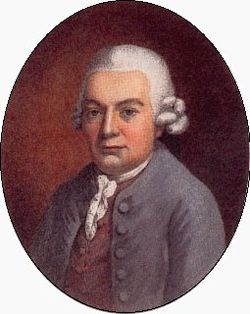
Nevertheless, I do not think it is entirely wrong to call C.P.E. Bach (Carl Philipp Emanuel Bach), whose 300th birth anniversary falls this year and who was the second son of the great J.S. Bach, the father of classical music in the narrow sense—the Classical style. Even Mozart said, “He is the father; we are the children.”12
That is how highly he was regarded.
Let us list some characteristics that distinguish Classical music from what came before it.
- A melody-plus-harmony texture (monophony)
- Multiple themes of differing character
- Themes shorter than in the Baroque, their decomposition into motifs, and the use and development of those motifs
- → Sonata form
These continued into the Romantic period and beyond, forming the core of “classical music” from the Classical era onward.
Meanwhile, C.P.E. Bach’s music is described as having the following characteristics.
- The galant style (melody plus harmony)
- The empfindsamer style3 (multiple themes of differing character)
- Short themes and decomposition into motifs, followed by their use and development (he is said to have been the first to decompose and use motifs4)
- A sonata in 3-movement form, and a movement consisting of an introduction + (first theme (tonic) + bridge + second theme (dominant/relative key)) x2 + development + recapitulation—that is, sonata form
Wait—those are exactly the characteristics of Classical music. No wonder Mozart called him “the father.”
His influence on Haydn, Mozart, and Beethoven was indeed conspicuous, and Beethoven apparently respected him as well5. Mendelssohn’s oratorio Elijah shows the influence of C.P.E. Bach’s The Israelites in the Desert, while Brahms apparently edited his works6.
Within the Bach family, his younger brother J.C. Bach had a close relationship with Mozart, and
- J.C. Bach → Mozart
- C.P.E. Bach → Beethoven
are sometimes said to be the stronger lines of influence. I cannot say that seems entirely wrong, but I also feel that C.P.E. Bach strongly influenced late Mozart. Late Mozart changed dramatically from his earlier “cheerful, simple homophonic music” toward elaborately constructed polyphonic music—difficult music in a sense7This produced the urban legend that he lost popularity and suffered debt because of his wife’s illness.8. The catalyst is said to have been the Bach music and scores shown to him by Baron van Swieten9.
Baron van Swieten was eccentric in a sense: he performed J.S. Bach, then almost completely neglected, at concerts in his home. His source material was the scores he had collected while stationed in Berlin. Why did he collect scores by the forgotten composer J.S. Bach? Probably because of C.P.E. Bach. When the Baron was in Berlin, C.P.E. Bach was also at the court there, working as accompanist and composer to Frederick the Great. At the same time, he was J.S. Bach’s greatest promoter. Although C.P.E. Bach enjoyed far greater fame as a composer than J.S. Bach at the time, he understood J.S. Bach’s greatness better than anyone. Thus the Baron collected J.S. Bach’s scores and returned to Vienna. Naturally, he brought back more than J.S. Bach’s works. He also brought works by C.P.E. Bach, who was then more highly regarded, and even commissioned and brought back a set of 6 symphonies for strings10.
Shall we listen?
C.P.E. Bach: Sinfonia in G Major, Wq. 182/1, H. 657 – I. Allegro di molto (composed 1773)
Here I would like to introduce the C.P.E. Bach Chamber Orchestra’s CD commemorating the 300th anniversary of his birth.

Wait—isn’t this simply Mozart…?
The following letter shows that Mozart had encountered C.P.E. Bach’s works by the time he composed the Haydn Quartets.
Letter (1)“By the way, I meant to ask you: when you return the rondo, please also send Handel’s 6 fugues and the toccata and fugue by Eberlin (Johann Ernst Eberlin 1702–1762).—Every Sunday at 12 o’clock I go to Baron van Swieten.—Nothing is played there except Handel and Bach.—I am now collecting Bach fugues, not only Sebastian’s but also those of Emanuel and Friedemann Bach (Wilhelm Friedemann Bach 1710–1784).—And Handel’s too. Only … is missing.—I want the Baron to hear Eberlin’s works.—You already know that the English Bach has died?—What a loss to the musical world!” (Mozart’s letter to Leopold, dated April 10, 1782)
(Source) Yoshiyuki Hara: “The Influence of Fugue on Mozart’s Late Keyboard Sonatas” 11
The next letter shows that Mozart was studying C.P.E. Bach during this period.
Letter (2)“I would be very grateful if you could copy Emanuel Bach’s fugues (I believe there are 6) and send them to me sometime.—I forgot to ask for them in Salzburg.” (Mozart’s letter to Leopold, dated December 24, 1783)
(Source) Yoshiyuki Hara: “The Influence of Fugue on Mozart’s Late Keyboard Sonatas”12
No wonder C.P.E. Bach sounds like late Mozart. Above I wrote that the catalyst was “the Bach music and scores shown to him by Baron van Swieten.” In fact, “Bach” here included J.S. Bach but also meant C.P.E. Bach13. Indeed, I suspect C.P.E. Bach’s influence was stronger. Otherwise Mozart would not have said at the outset, “He is the father; we are the children.”
Was Schumann the reason C.P.E. Bach was forgotten?
Why, then, was such an important composer as C.P.E. Bach forgotten by the 19th century? One cause seems to have been Robert Schumann. His judgment—“As a creative musician, he is far too inferior to his father”—appears to have resonated. As you know, Schumann was a highly influential critic at the time, so such an assessment from him was devastating. In the end, C.P.E. Bach became a composer understood only by “the very few who knew,” such as Brahms and Mendelssohn. What a pity!
In Schumann’s defense, C.P.E. Bach, like many composers of his time, was enormously prolific and wrote plenty of poor works. He was both a pioneer and an experimenter, so many failures were inevitable. After encountering several poor works in succession, it is understandable to conclude, “This is no good.” In a sense, I did the same.
I reconsidered C.P.E. Bach after visiting Leipzig in March this year and seeing a poster marking the 300th anniversary of his birth. C.P.E. Bach grew up in Leipzig. In the past, recordings would still have been unavailable, and someone like me could not have listened and reevaluated him. But today we have the Naxos Music Library! There, many of C.P.E. Bach’s works can be heard without limit. What a wonderful age.
Wanting to investigate C.P.E. Bach, I looked into where to begin listening. His breakthrough works appeared to be 2 sets of keyboard sonatas, the Prussian Sonatas and Württemberg Sonatas14. Casually, I began listening to Ana-Marija Markovina play the Württemberg Sonata No. 1 (composed 1742)15. I was listening in the background, but shortly after movement 3 began, I thought “Wait a moment” and immediately listened again. “This is sonata form.”
Listening again with the score confirmed it was exactly sonata form. More than that, “the bridge between theme 1 and theme 2 contains the ‘fate motif’16 and drives it relentlessly through the development. What is this?” That is when I began seriously researching C.P.E. Bach.
So first, let us listen to the Württemberg Sonatas. I compared various performances, and Markovina is the best. Incidentally, the piano appears to be a Bösendorfer.
C.P.E. Bach: Württemberg Sonatas Nos. 1–6 (1742–44)
[AMAZONPRODUCTS asin=”B00I9GDGXU”]

As noted above, No. 1, movement 3, is in sonata form. The left hand repeatedly strikes chords while the right plays a monophonic melody, a galant texture; its first and second themes have different characters, making it an empfindsamer-style piece—or rather, sonata form necessarily makes it so. Composed in 1742, it dates from when the great Bach was of course still alive17. So far, I have not encountered an older example of sonata form.
All are in a fast-slow-fast 3-movement form. By No. 3 (Wq. 49-3, 1743), sonata form appears from movement 1. The movement’s theme is a Baroque-style melody in dotted rhythm, yet it strangely smells of Beethoven.

This becomes still more conspicuous in No. 6 (Wq. 49-6, 1744), which sounds somewhat like Beethoven’s piano sonatas from No. 30 onward18. His influence on Beethoven is discussed for good reason. Just how advanced was he? Beethoven’s No. 30 (Op.109) dates from 1820… a gap of 76 years.

This CD actually also includes a piano concerto. Let us hear it.
C.P.E. Bach: Piano Concerto in D Minor, Wq. 23, H. 427 (composed 1748), Markovina (piano), Saxon Chamber Philharmonic conducted by Rungo

The harpsichord continuo is Baroque, but apart from that this is truly “sorrow in flight”—though that is Mozart’s catchphrase. It is in ritornello form, and the piano’s entrance after the orchestra states the theme is stirring and moving. I recommend the piece, but please hear the Markovina/Saxon Chamber Philharmonic performance introduced here. It needs a piano to create the right atmosphere, and other performances are too slow to become “sorrow in flight.” This may be another reason C.P.E. Bach has received so little recognition. If one assumes it is Baroque and performs it at a Romanticized Baroque tempo in a Baroque manner, it simply fails. Markovina’s recordings, made after 10 years spent studying and recording C.P.E. Bach, reveal this. They truly deserve praise.
[AMAZONPRODUCTS asin=”B00I9GDGXU”]
Footnotes
- The Guardian: CPE Bach: like father, like son, (2011-02-24) The original German is “Er ist der Vater; wir sind die Buben.” Could the claim in Japanese music education that “Bach is the father of music” possibly be a mistaken interpretation of this remark?
- Wikipedia, Carl Philipp Emanuel Bach (retrieved 2014/8/27)
- The empfindsamer style (German: Empfindsamer Stil; English: Sensitive Style) was a musical style created in 18th-century Germany. It sought to express “sincere and natural emotion” and was characterized by sudden changes of feeling. It developed in contrast to the Baroque doctrine of Affektenlehre, under which a single emotion should dominate an entire piece or movement.
- Wikipedia, “Sonata Form,” http://en.wikipedia.org/wiki/History_of_sonata_form(2014/8/27取得)
- citation needed
- Wikipedia, Carl Philipp Emanuel Bach, Influence on Later Generations (retrieved 2014/8/27)
- This can also be seen in the fact that Mozart, who previously almost never made mistakes in writing, apparently revised the Haydn Quartets (1782–1785) repeatedly. Is that really true? I merely remember reading it in a book by Hidekazu Yoshida or someone else more than 30 years ago…
- In reality, Mozart’s income never fell below ¥20 million in present value, and in the year of his death he was earning at an annual rate of 60 million. He was also extremely meticulous and kept proper accounts, apparently making him the opposite of the figure portrayed in the play and film Amadeus. He wrote many letters requesting loans, but these are better understood as requests for additional investment in a corporation he had founded rather than personal loans. In the end, he personally assumed the corporation’s liabilities.
- Sinfonias Wq. 182/1–6, H.657–662 (composed 1773)
- Sinfonias Wq. 182/1–6, H.657–662 (composed 1773)
- https://www.seitoku.ac.jp/daigaku/music/mozart06/writings/haramfugue/haramfugue.html
- Yoshiyuki Hara: “The Influence of Fugue on Mozart’s Late Keyboard Sonatas” https://www.seitoku.ac.jp/daigaku/music/mozart06/writings/haramfugue/haramfugue.html (retrieved 2014/8/28)
- The text by someone who wrote something like “the Bach music and scores shown to him by Baron van Swieten” clearly meant the great Bach. That was somewhat inaccurate.
- As an aside, he was left-handed and therefore poor at string instruments, so unusually for his time he made the keyboard his principal field. His book on playing keyboard instruments was highly regarded from its publication and went through multiple editions. It apparently promoted a revolutionary technique: using the thumb. Yes—before then, keyboard players apparently avoided the thumb wherever possible. Thus C.P.E. Bach was also a father of modern piano technique.
- Dates of works are from Naxos and http://t-yoko.sakura.ne.jp/cpe_bach.htmlの両方を見比べて入れました。
- the familiar da-da-da-dum rhythm
- the first draft of The Art of Fugue dates from 1742
- although movement 3 returns to a Baroque style. This lack of final polish is also characteristic of C.P.E. Bach. Perhaps he intentionally wanted the audience of his day to settle down at the end with a familiar style.
Related posts
Season’s Greetings—Bach: Siciliano (Flute and Spinet)
Season's greetings once again this year. I present Bach's Siciliano, mainly against a backdrop of scenery from Sicily. The flute I am using was made in…
Bach’s “Toccata and Fugue in D Minor, BWV 565”: Originally a Violin Piece?
Is Bach's “Toccata and Fugue in D Minor, BWV 565” by Someone Else? One of J.S. Bach's best-known works is the “Toccata and Fugue in D…
Visiting C. P. E. Bach’s Grave: St. Michael’s Church in Hamburg
Because I was traveling from Berlin to London on Sunday and had Saturday free, I went to pay my respects at the grave of C. P.…