
In an earlier article, “Meaningful Consent and the Standard Information Sharing Label,” I explained that it is unrealistic to assume users read, understand, and consent to privacy policies and terms of service. As one way to improve this situation, I introduced the Standard Information Sharing Label being standardized by the Kantara Initiative.
The Standard Information Sharing Label should basically be provided by the information provider. By itself, it does not evaluate whether the privacy policy or terms of service are good or bad.
Today I will introduce a related project: “Terms of Service; Didn’t Read” (ToS-DR).
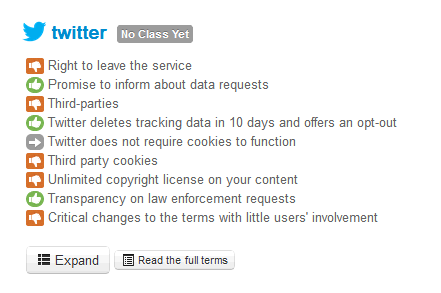
The ToS-DR project uses crowdsourcing to read each vendor’s terms of service (ToS), rate them on several criteria using a 5-level scale, and present the results graphically. For example, this is what everyone’s beloved Twitter looks like.
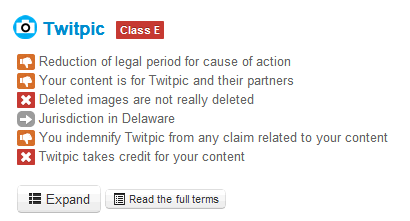
Green icons indicate positive points, while orange icons indicate negative points. Overall, Twitter appears to be about average among today’s Web services. By contrast, Twitpic looks like the following: it is a parade of red X icons, which are worse than orange, showing that it is a rather alarming service.
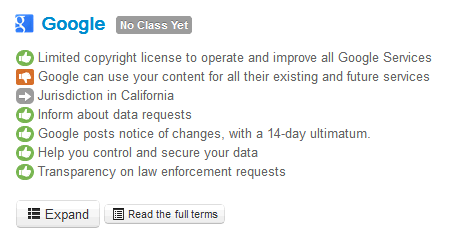
Meanwhile, Google is frequently viewed as problematic, but its result looks like this and is actually relatively good.
What do you think? Easy to understand, is it not?
The major difference between the Standard Information Sharing Label and ToS-DR is that the former is self-reported by the provider, whereas the latter is a third-party assessment.
Self-reporting can naturally provide broader coverage and track current conditions more closely. But if providers evaluate themselves, the results may not be very trustworthy. Third-party assessment is much more reliable, but its coverage and ability to keep pace are necessarily limited. The consequences of inaccurate displays also differ. Because the Standard Information Sharing Label is self-reported, deliberately acting contrary to it would constitute unlawful conduct by the service provider. That is not the case with a third-party assessment. From the standpoint of corrective power, therefore, the Standard Information Sharing Label may be stronger. In ease of understanding, however, ToS-DR wins decisively.
For that reason, I think both services are necessary.
ToS-DR is currently running as a project through September, after which its future will be discussed. It looks like a very interesting project, so I intend to keep watching it.
Related posts
Data Sustains Lives—MyDataConference 2026 Opening Address
The following is the opening address for the MyData Japan Conference 2026, delivered by Nat Sakimura in his capacity as Chair of the General Incorporated Association…

The MyData Conference 2026 Is This Wednesday. See You at Hitotsubashi Hall!
I have been posting announcements on X every few days, and the MyDataJapan Conference 2026 is this Wednesday. There are many highlights: Naohiro Fujie, Representative Director…
Unsubmitted Public Comment on the Call for Comments on the Draft First Report of the Youth Protection Working Group on Information Distribution in the Digital Space
July 823:59 was the deadline for the call for comments on the draft first report. I ended the FAPI WG early and23:40 began the submission process…
You must be logged in to post a comment.