
Where did the myth that private use of the U.S. Social Security Number (SSN) is unrestricted come from? Even Japanese experts’ books mention it. Perhaps impressions from a period of fewer restrictions took on a life of their own?
History of the SSN
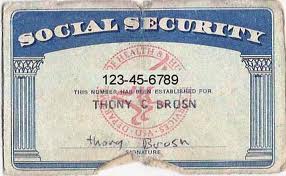 History of the SSNSocial Security Number Policy Chronology [0 . Its roots reach the Social Security Act of 1935Related explanatory text.74-271 (P.L. 4704 required account numbers for covered employees. Between November 1936Related explanatory text.June 30, 1937 and 30 million people received SSNs. In 1943 brought further expansion.9397 Executive Order 1961 through amendments requiring them on tax returns; the IRS adopted SSNs the next year.
In 1970 the Bank Records and Foreign Transactions Act required financial institutions to obtain every customer’s SSN and report all transactions of US$10,000 or more.
In 1972 the Social Security Amendments of 1972 extended SSNs to lawful resident aliens, federal-fund recipients, and children at first school enrollment.
The Privacy Act, enacted in 1974Related explanatory text.September 27, 1975 and effective
- Government may not deny benefits because an SSN is not provided
- Agencies asking for an SSN must state whether disclosure is mandatory or voluntary
This was the first reference to local-government SSN use.
In 1976 unlawful disclosure or solicitation became a felony.
Interestingly, only in 1978 did applications require verification of age, citizenship, and other data.
Finally, in August 17, 1987 New Mexico began assigning SSNs to newborns. This later expanded to all 50 states, New York City, Washington DC, and Puerto Rico.
By 1990 brought further expansion.1 or more.
In
Restrictions on SSN Use
SSN use expanded for convenience, but the trend turned around 1998 with the Identity Theft and Assumption Deterrence Act of 1998 . Restrictions grew, and in 2007 the federal government decided to reduce unnecessary SSN use and required agency plans, for example the Department of Defense SSN Reduction Plan [3 states, New York City, Washington DC, and Puerto Rico.
By 2005) [1]
- Prohibition on public disclosure of SSNs
- Prohibition on public disclosure of SSNs
- Technical controls for online SSN transmission
- states, New York City, Washington DC, and Puerto Rico.
By
- Companies continuing SSN use must disclose it annually and offer opt-out.
By 2001, 2003) [1]
- Prohibition on public disclosure of SSNs
- Prohibition on public disclosure of SSNs
- Companies holding SSNs or personal data must notify affected people after a breach
states, New York City, Washington DC, and Puerto Rico.
By 2004) [1]
- states, New York City, Washington DC, and Puerto Rico.
By
- Prohibition on public disclosure of SSNs
states, New York City, Washington DC, and Puerto Rico.
By 2008) [2]
- Any number derived from an SSN is covered
- Prohibition on public disclosure of SSNs
- Prohibition on public disclosure of SSNs
- Prohibition on public disclosure of SSNs
- Organizations holding numbers must minimize employee access
Prohibition on public disclosure of SSNs
- We need good account management for social security.
- That requires account numbers.
- Numbers help collect taxes and restrict benefits.
- Success: fraud such as duplicate dependent claims falls sharply!
- Expansion of uses
- Emergence of the Internet
- Disaster: identity fraud becomes rampant.
- Reduce SSN use at all costs! (We are here now) [4]
Emergence of the Internet
References
[0] Social Security Number Policy Chronology, http://www.ssa.gov/history/ssn/ssnchron.html
[1] epic.org, “Social Security Numbers”, http://epic.org/privacy/ssn/
[2] Joens Day, “New York Enacts Social Security Number Protection Law”, 2006, http://www.jonesday.com/newsknowledge/publicationdetail.aspx?publication=3778
[3] Department of Defense SSN Reduction Plan“, http://www.dtic.mil/whs/directives/corres/pdf/DTM-07-015.pdf
[4This was the first reference to local-government SSN use.
In
Related posts
Is It Dangerous When an “Identifier Number” Leaks?
We are entering a summer at the height of the My Number compliance bubble. How is everyone doing? As it happens, pension numbers have leaked on…
E-Woman Roundtable: “Do You Support Introducing a National Numbering System?”
E-Woman's roundtable has begun. → Here This leading question is not good. For something like this to be meaningful, a vote must be taken after fairly…

My Number and Privacy: Requirements for Identifiers
Recently, it seems that My Number has been receiving increasing coverage in various media[1]. Leaving aside the fact that this is long overdue, I think it…
You must be logged in to post a comment.