
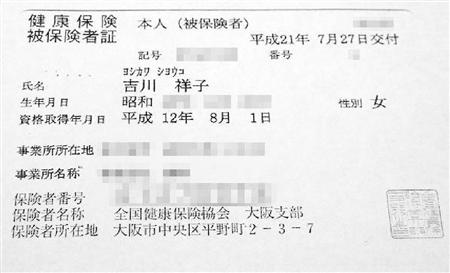
It has become a topic of discussion that Akemi Saito (49), the suspect who had been harboring former Aum member and suspect Hirata, obtained a health insurance card under an alias and then used it as identification to open a bank account[1]. In response, various opinions have appeared on my Twitter timeline. Many, like the news reports, see the problem as the fact that identification could be created under an alias, while others say that this misses the point. I would therefore like to take a little time to sort out the issues.
The issue in this case is that Saito obtained a health insurance card in the name of “Shoko Yoshikawa,” the name she used when working at an osteopathic clinic in Osaka, and used it to open bank accounts and the like.
According to news reports, this health insurance card was first obtained in August 2000[2], so at the time it would have been issued under government-managed health insurance.
The Health Insurance Card Issuance Process
How, then, is a health insurance card issued?
If you visit the website of the Japan Health Insurance Association (Kyokai Kenpo), you will find that the procedure is explained on the Japan Pension Service website. According to that explanation, it appears that the employer of the insured person merely submits the “Notifications Concerning Acquisition or Loss of Insured Status and Dependents”. Indeed, in the article[1], the Japan Pension Service’s Public Relations Office explains it as follows.
“An application is made by submitting a ‘Notification of Acquisition of Insured Status.’ A resident record or certified copy of the family register does not need to be attached. The system assumes that the employer has verified the person’s identity before applying. Penalties are provided for false applications (imprisonment for up to 6 months or a fine of up to ¥500,000).”
Looking at the “Notifications Concerning Acquisition or Loss of Insured Status and Dependents”, a Basic Pension Number (from 1997 onward) is generally required in addition to the person’s name, sex, and other details, but perhaps it was not required at the time? Well, judging from the missing pension records scandal, one can infer that management in this area was lax (for example, a new number may simply have been assigned when none existed). At the time, the Basic Resident Register Network was not yet operational, and of course there was no cross-check against the Basic Resident Register. The system can be said to assume that identity verification has already been performed by the time the application is submitted. In practice, however, identity verification was often not performed at small and medium-sized companies[3].
As Long as a Health Insurance Card Is Used as a Health Insurance Card, There Is No Problem
So what is the problem here?
First, let us consider a health insurance card as a means of certifying and identifying eligibility within the health insurance system.
To be issued a health insurance card, a person needs an employment record at the company, so the link between the “identity” created in this way and the physical person is quite strong[4]. It is therefore difficult to obtain 2 cards at the same time. If you worked without sleeping at night, it would be possible to be employed at 2 workplaces and obtain 2 cards, but insurance benefits can be received only once for the same physical person. You would merely lose money by paying the premiums, so there would be no point. From the original perspective of health insurance—everyone pays premiums, and those who become ill receive benefits from the pooled money—this is sufficient. There is absolutely no necessity to use one’s family-register name to receive hospital treatment.
The Fault Lies with Those Who Use Health Insurance Cards for an Unintended Purpose: “General Identity Verification”
Next, let us consider a health insurance card as a means of identity verification outside the health insurance system. One example is the prevention of money laundering (under the Act on Prevention of Transfer of Criminal Proceeds).
There are various money-laundering techniques, but let us consider a very simple one here. A person named “Minoru Tanaka,” who has been flagged by the authorities, opens an account under another person’s name, “Shigeru Suzuki,” and has illicit funds transferred into it. This can be accomplished by obtaining a health insurance card in the name of “Shigeru Suzuki” using the method described above. It makes no difference even if the health insurance card bears a photograph.
In other words, a health insurance card is, by its essential nature, unusable for identity verification outside the health insurance system. But since that was never its intended use, the party at fault is the one performing identity verification by using it in a manner not intended by the issuer. A document that can be used for identity verification under the Act on Prevention of Transfer of Criminal Proceeds must permit records to be matched by individual within the scope of that Act. A health insurance card does not.
Must People Work Only Under Their Family-Register Names in the First Place?
Many people say, “No, that is not the case. It would have been fine if the health insurance card had simply been issued correctly under the person’s real name.” They then criticize the Social Insurance Agency’s administration at the time as inadequate.
But is that really so?
There are always some people who are at risk of becoming crime victims (for example, someone being pursued by an abusive husband). These are people who are being chased. Yet the police generally will not treat the matter as a case until the person actually becomes a victim. From that person’s perspective, it is far too late if the police take up the case only after she has been killed. The only way to protect herself is to flee. For reasons like this, some people apparently live and work under aliases as attendants at hot-spring inns deep in the mountains while raising their children. It seems that social insurance offices at the time sometimes recognized that such names were aliases and nevertheless tacitly issued health insurance cards under them. After all, requiring a family-register name could cause it to leak from the workplace. Is that not a fine, humane story? In fact, I believe this is “justice.” Which is better: mechanically applying the rules, forcing people to use their family-register names, and thereby creating crime victims, or allowing this? A world in which people can work only under their family-register names is far too restrictive and inhumane.
In fact, Germany permits the use of pseudonyms, while in the United States a person’s real name is the name that the person ordinarily uses. I understand that people may call themselves anything they wish unless their purpose is to deceive someone and cause harm.
Even “Pablo Picasso’s” “real name” was “Pablo Diego José Francisco de Paula Juan Nepomuceno Crispín Crispiniano de la Santísima Trinidad Ruiz Blasco Picasso y López,” and he supposedly could not even remember it himself(citation needed), so surely “Pablo Picasso” was his real name. More fundamentally, the idea that a “real name (family-register name)” consists of a family-name and given-name combination is not universal. Japanese people’s “real names” are simple, but that is not the case throughout the world.
What Is Identity Verification in the First Place?
The reason people insist that identity verification must always use a family-register name or must be absolutely certain is, I think, that they do not understand the essential meaning of “identity verification.” What is “identity verification”?
I will quote the definition in ITU-T X.1254 | ISO/IEC DIS 29115[5].
3.14 Identity Proofing[Identity Proofing]
A process in which the Registration Authority (RA) obtains and verifies enough information to identify the entity to a specified or understood level of assurance [Process by which the Registration Authority (RA) captures and verifies sufficient information to identify an entity to a specified or understood level of assurance.]
In other words, when conducting identity verification, one must decide in advance for what purpose and with what degree of certainty it is to be performed, and then collect and verify various pieces of information toward that end. Absolute identity verification does not exist. When a health insurance card is used as a health insurance card, the current process is sufficient, as discussed above. To put it another way, the fine for making a false application is ¥500,000, which tells us that the system contemplates transactions involving at most around ¥500,000 in potential losses. If people want it to be more rigorous so that it can also be used for other purposes, then the “people who use it for other purposes” should bear that cost. Otherwise, the demand is unreasonable.
Moreover, if identity verification is made to use a family-register name at all times, various fundamental human-rights issues emerge, including risks to life and physical safety, privacy problems, and freedom-of-speech concerns, as discussed above. What do the people who make such demands intend to do about all these issues?
Furthermore, in Japan today, the term “identity verification” is used to mean many different things.
- “Identity verification” when first creating an “account” linked to a particular “person”
- “Identity verification” to link a physical person to an already existing “account”
- “Identity verification” to confirm access authorization for an “account”
- “Identity verification” to create a “certificate” that others can use when performing “identity verification”
And so on. To conduct a sound discussion, we must properly distinguish and organize these concepts when using them. Admittedly, Japan is not the only place where they are muddled together, but I hope everyone who has read this article will be sure to consider them separately. Doing so will reveal many things.
[1] Former Female Cult Member’s Health Insurance Card Causes a Stir! It Could Be Made Even Under an “Alias”, Zakzak, 2012/1/16, among numerous reports.
[2] Nikkei Online Edition 2012/1/13 In addition, the copy of the health insurance card shown in the article lists the date on which eligibility was acquired as August 1, Heisei 12.
[3] The osteopathic clinic where Saito worked reportedly did not verify her identity using a resident record, driver’s license, or similar document when applying for her health insurance card. “When a person changes jobs, a large company’s health insurance society will always require submission of a ‘Certificate of Loss of Eligibility’ showing that the person has withdrawn from the previous society. But when the employer is a small or medium-sized company, this step is often omitted” (social insurance and labor consultant), suggesting that there was a problem at the application stage. (Source: [1] Former Female Cult Member’s Health Insurance Card Causes a Stir! It Could Be Made Even Under an “Alias”)
[4] Frankly, the link is far stronger than the link between a resident record and the physical person. In fact, essentially nothing directly links a resident record to the physical person.
[5] ISO 24760-1 would probably be preferable, but it would make this too long, so I have used 29115 here. I plan to discuss matters related to 24760-1 in a separate article.
Related posts
Summary and Personal Impressions of Digital Minister Kono’s 10/13 Press Conference, Which Covered Many Important My Number Card Topics Beyond Integration with Health Insurance Cards
On October 13, at around 10 o'clock, Minister Kono held a press conference on efforts to promote adoption of the My Number Card. Several important announcements…
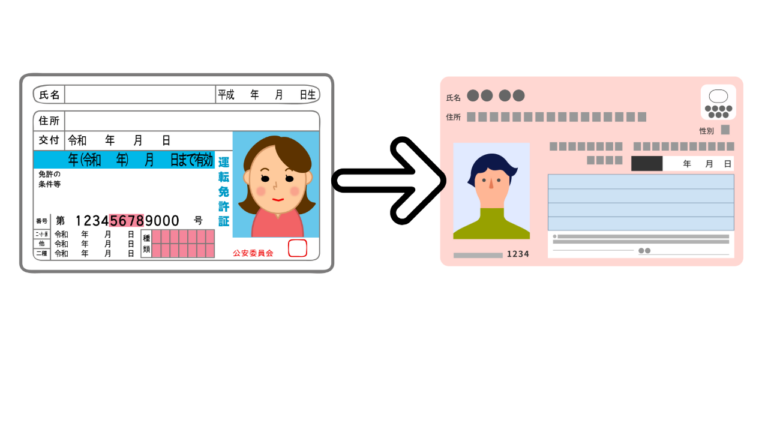
“My Number Driver’s License” to Be Introduced in 25 on March: One-Stop Address Changes and Online Renewal Courses
The integration of driver's licenses and My Number Cards will soon become a reality. This groundbreaking change could have a major impact on our daily lives.…
Challenges in Distributing a National ID
Some argue that, for government efficiency, Japan should simply use the Basic Resident Register Network to distribute national IDs without delay. Certainly, if they could be…
You must be logged in to post a comment.