
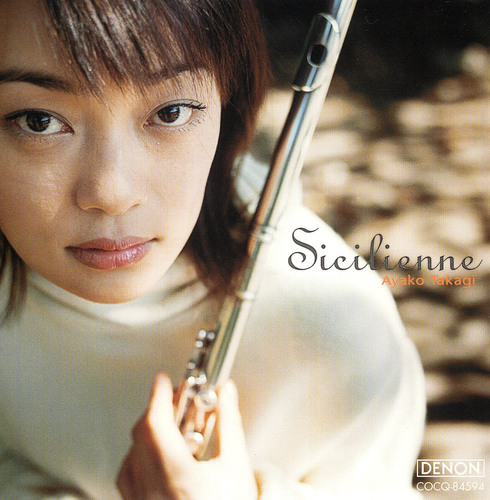
 Ever since hearing this piece on Ayako Takagi’s CD “Sicilienne”, I had thought it was beautiful without properly researching it. Feeling remiss, I finally looked into it.
François Bazin1 wrote the opéra comique “Maître Pathelin2” (1856). Although its “Romance” is still performed, the opera itself is now rarely heard. Its source is the anonymous3 medieval French comedy4, “La Farce de maître Pierre Pathelin” (“The Farce of Master Pierre Pathelin”). It is a masterpiece that embeds the sorrow of a person left behind by changing times within its comedy5. Three times as long as other farces and outstanding in quality as well, it is considered the representative medieval comedy6. Incidentally, a Japanese translation was published in the Iwanami Bunko series7. It is out of print, but I obtained a used copy this time.
Master Pathelin is a poor lawyer in a small village in France’s Lower Normandy region. At the time, national institutions were gradually becoming established and formally educated lawyers were beginning to appear. Unfortunately, Pathelin belongs to the previous generation of lawyers and has no such professional education. Naturally, properly trained lawyers take his work, leaving him so poor that both he and his wife wear clothes full of holes. Pathelin therefore devises a scheme. He visits the cloth merchant Guillaume Joceaulme, flatters him lavishly, and persuades him to sell 6 yards of fine fabric on credit.
Pathelin promptly takes the cloth home and tells his wife Guillemette that Guillaume will come to collect payment. He instructs her to act as though Pathelin has already been bedridden for 3 months. When Guillaume arrives for the money, he finds Pathelin apparently delirious after a long illness and gives up trying to collect.
Then the shepherd Thibaud comes to ask Pathelin for help. He has stolen and eaten Guillaume’s sheep, been discovered, and is now being sued. He wants Pathelin to defend him. It is Pathelin’s first work in a long time, so of course he accepts. He orders Thibaud to say nothing in court except “Baa,” like a sheep. The idea is to survive the trial by pretending to be insane.
At the trial, Guillaume discovers that Thibaud’s disguised counsel is Pathelin. He tries to tell the judge both that Pathelin swindled him out of the cloth and that Thibaud stole his sheep, but the stories become hopelessly tangled. Meanwhile, whenever asked to testify, Thibaud says only “Baa.” Pathelin’s scheme succeeds perfectly, and Thibaud is safely (?) acquitted. Pathelin then asks Thibaud for his legal fee. But Thibaud still says nothing except “Baa”! Realizing that his groundbreaking tactic is now being used against him, Pathelin gives up and goes home.
The original work has 5 characters.
- Master Pierre Pathelin (Maître Pierre Pathelin), a ruined lawyer. Shrewd and eloquent.
- Guillemette — Pathelin’s wife. She pretends that Pathelin is ill and deceives Guillaume.
- Guillaume Joceaulme — the cloth merchant who sells fabric to Pathelin. A thoroughly dishonest man, but this time he is the one deceived.
- Thibaud l’Agnelet — the shepherd who asks Pathelin for help. In the end he deceives Pathelin.
- The Judge (Le Juge) — presides over the trial between Guillaume and the shepherd.
Bazin’s opera, however, adds more characters8.
- Angélique — Pathelin’s niece. (Her name means “angelic.”)
- Charlot — a boy whose guardian is the cloth merchant Guillaume.
- Bobinette — Pathelin’s maid and the shepherd l’Agnelet’s fiancée.
The Romance in question (Romance de Charlot) is sung not by Pathelin but by Charlot to Angélique. He loves her, but that love is not going well. Charlot pours out his feelings.
French lyrics:
Je pense à vous quand je m’éveille
Et de loin, je vous suis des yeux.
Je vous revoie quand je sommeille
Dans un songe mystérieux.
Le seul bonheur auquel mon cœur aspire,
C’est d’obtenir un « à vous » les plus doux :
Voilà, voilà ce que je veux vous dire,
Mais hélas, j’ai trop peur de vousQuand je guette votre passage,
Lorsque j’espère enfin vous revoir,
Je dis dans un doux langage :
« Aujourd’hui je venais vous voir ».
Je veux, je veux dans un brûlant délire
Dire « Je t’aime » en tombant à genoux :
Voilà, voilà ce que je veux vous dire,
Mais hélas, j’ai trop peur de vous
I think of you when I awake
And from a distance, I follow you with my eyes.
I see you again when I drowse
In a mysterious dream.
The only happiness to which my heart aspires
Is to receive the sweetest “Yours”:
That, that is what I want to tell you,
But alas, I am far too afraid of you.When I watch for you to pass,
When at last I hope to see you again,
I say in gentle words:
“Today I came to see you.”
I want, I want, in burning delirium,
To fall to my knees and say “I love you”:
That, that is what I want to tell you,
But alas, I am far too afraid of you.
My own translation:
When I awake, I think of you.
From afar, I follow your eyes.
When I doze, I see you
Within a mysterious dream.
The happiness my heart desires
Is only the sweet whisper, “Yours.”
I have something I want to tell you, to tell you,
Ah, but I am far too afraid to say it.I wait in ambush along the path you take.
When at last I meet you,
I whisper softly,
“Today I came to see you.”
In a blaze of madness,
I want to kneel and say, “I love you.”
I have something I want to tell you, to tell you,
Ah, but I am far too afraid to say it.
So pure and lovely (gazes into the distance).
Still, when I once happened to sit next to Ayako Takagi at an okonomiyaki restaurant in Miyazaki9, I suppose there is something admirable about the fact that even I could not say, “I’m a fan; please give me your autograph” (laughs).
And now, please enjoy Piotr Beczala’s performance.

Footnotes
- born in Marseille on 1816/9/4; died in Paris on 1878/7/2
- Maître Pathelin
- there are various theories, but it is probably attributed to Triboulet, the jester of René d’Anjou, namely Triboulet
- a verse play written in 1457 and regarded as France’s first comedy; its first edition appeared in 1464. It is “a supreme masterpiece of medieval theater that not only influenced writers and dramatists of the 16th century, including Rabelais, but left traces even in modern French” (Taku Kuroiwa, associate professor at Tohoku University, from Issues Surrounding ‘Maître Pierre Pathelin’). The judge’s line in the chaotic courtroom scene, “Let us return to the sheep,” is said to have become an idiom meaning “Let us return to the point” (Hitsuji News, from “Maître Pierre Pathelin”)
- it was performed very frequently then and apparently still is; YouTube has many versions performed by children and others
- Yasushi Sato, Aspects of Medieval Theater http://www4.ocn.ne.jp/~ysato/moyen.htm
- translated by Kazuo Watanabe, Maître Pierre Pathelin, Iwanami Bunko (1995 fourth printing [1965 first printing])
- André Tissier, “Recueil de farces (1450-1550),” P.135
- Ayako Takagi: Sicilienne—this is beside the point, but once I happened to sit beside the visibly pregnant Takagi at the counter of an okonomiyaki restaurant. It was at the party after a performance of Stravinsky’s “The Fox” at the Miyazaki International Music Festival. I wish I had asked for her autograph. I have been a fan ever since hearing Takagi, probably still a student then, play “Winter in Buenos Aires” on FM radio in my car.
Related posts
“Doppler: Andante and Rondo, Op. 25” in the Mirror
About Franz Doppler Franz Doppler (1821-1883) was a Hungarian-Austrian composer, conductor, and flutist. As the composer of the famous “Hungarian Pastoral Fantasy,” he is known to…
【Goosebumps】A Badly Behaved Schoolgirl Bursts into an Orchestra! But Once She Starts Singing, Her Extraordinary Performance Leaves Everyone Speechless?
The article named in the title appeared in my SmartNews feed. It said: “A performance by the London Symphony Orchestra conducted by Barbara Hannigan. A schoolgirl…
Does Rilakkuma Appear in the Semperoper Dresden’s Salome?!
On October 17, at the Dresden State Opera , I went to see R. Strauss's (1864-1949) Salome. I had done no advance research at all, but…