
—The market has plunged since the start of the year. It has expressed no confidence in the government’s budget proposal, but the government…—
In the January issue, I mentioned how terrible the government’s budget proposal was, but apparently I was not alone in feeling that way. Since the start of the year, the stock market has plunged, expressing no confidence in the Hashimoto administration in the clearest possible way.
Yet the government’s response is so poor that it hardly seems worth criticizing. It says that we should not be misled by immediate market movements, and so on. Government leaders apparently have some fundamental misunderstanding.
When markets plunge, the current government seems to think of measures such as supporting stock prices. But what markets demand is, of course, not such short-term patchwork. This decline has coincided with a weaker yen; in short, it is a sell-off of Japan. The market has judged that if the country continues to be run as it is, Japan will fail in the long term.
That market judgment is probably broadly correct. Japan has reached a point at which it must fundamentally change the way it is run.
How should it do so? Put plainly, by introducing market principles into the public sector. Concretely, this is close to the recently discussed idea of local fiscal decentralization. Tax revenue raised in a locality should belong to that locality. Using those resources, the locality should manage itself, whether city or otherwise, as though it were a company. Naturally, if management is poor, that city will lose residents and businesses and “go bankrupt.” Its goal should, of course, be the long-term maximization of revenue, namely tax revenue. Raising tax rates recklessly will drive out businesses and residents and reduce revenue. But lowering them too much, exhausting resources and degrading city services, will also cause residents to leave. Municipal incorporation is called “incorporate into city” in English; a city must indeed be judged by the management sense of a corporation.
Opinions will differ about which level of local government should be treated as an independent “company,” but I think the city level is best, because it is appropriate as a human living area. At the town or village level, populations are too small and finances would fail, while management efficiency would worsen; these should therefore be treated together as prefectures. The current hierarchy of nation–prefecture–city, town, and village would collapse, and prefectures (towns and villages) and cities would become equals.
Meanwhile, under this framework the national government’s role would be much more limited than now: it would handle macro issues such as diplomacy and currency policy, and adjustment of externalities involving wide areas. Local governments would contribute the national government’s revenue, instead of the nation collecting taxes and distributing them locally as it does now. This would break the present harmful situation in which the nation effectively controls local governments.
Japan today is, so to speak, a huge company whose head-office structure has become bloated and sluggish. Such a company will eventually collapse. To save it, the head office must be boldly restructured and authority delegated to the front line—local governments in this case. If this is not done, Japan will have no choice but to become a twilight country sinking while clinging to the glory of former days.
Related posts
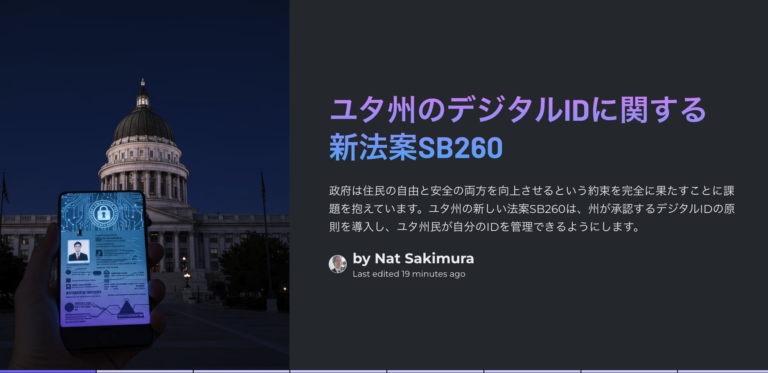
Anyone Who Thinks Identity Is Given by the State or Government Should Sit Up and Read This: Utah Digital ID Bill SB260 and the Transformation Brought by a User-Centric Digital ID System
As digital technology evolves, our dependence on personal information and data continues to grow. Yet many government-provided ID systems do not always give sufficient consideration to…

The Provider Liability Limitation Act Has Become the Information Distribution Platform Act (May 10)
Following deliberations by the Ministry of Internal Affairs and Communications’ Study Group on Platforms, of which I was also a member, the amended “Provider Liability Limitation…

MyData Japan submitted comments in response to the public consultation on the “Order Partially Amending the Regulation for Enforcement of the Act on Certification Business of the Japan Agency for Local Authority Information Systems Pertaining to Electronic Signatures, etc.”
In response to the public consultation announced on January 26 regarding the "Draft Order Partially Amending the Regulation for Enforcement of the Act on Certification Business…