
“There is no omniscient, omnipotent, benevolent God. The proof is simple: all the unhappiness in this world is proof of it.”
Preference Relations
People live their lives day by day. Life is an accumulation of choosing, from the available options, what each person considers best. For example, you are reading this document now. This is the result of your preferring to read it, at this point, over any other action and choosing to do so. You must have had other options, but you chose to read these lines.
If you act rationally, you will repeat these “choices” with the intention of making yourself as happy as possible. Unfortunately, we cannot see the future, so a choice that seems best now may not necessarily turn out to have been best in the future.
In other words, this is what I mean.
From a collection of options (which I shall call the feasible set), you choose the option that you think is best under the information available to you. As a result, you reach a particular level of satisfaction (which I shall call the utility level). The criterion by which you choose is called a preference relation. Preference relations are ordinarily affected by the state of society.
If the number of options decreases, the level of satisfaction that can be attained also decreases. More precisely, when the set of options becomes smaller, the attainable utility level can never become higher. This is simple. Suppose one set of options is contained in another. If the highest point is in the smaller set, it is also in the larger one; thus the best option in the larger set can yield at least as much utility as the best option in the smaller set. In short, the larger the set of options, the happier one can be.
What I have described above is, in fact, the very foundation of economics.
There is one thing of which we can be certain.
If we can expand the set of options, we cannot be worse off than before it was expanded.
Then, in the real world, how is the set of options determined?
The Set of Options
Economics usually assumes that the set of options is determined by initial endowments and technology. Initial endowments mean what resources one possesses at the outset and what rights one has; technology means the technology for producing things. For the sake of simplification, initial endowments are usually treated as though they consisted only of economic assets, but they are a broader concept. Social norms and similar matters should properly be included, but for the purpose of explaining how the economy works they are merely extraneous factors. They are therefore normally ignored, or incorporated into preference relations and treated as given rather than altered.
Here, we shall depart from economics. Let us consider more closely how the set of options is determined in the real world.
The constraints discussed in economics, such as budget constraints, of course narrow our options. But when we look carefully around us, there are many other constraints as well.
They are laws, and social norms called common sense.
For example, in Asian countries, it is natural for a mother to breastfeed her baby, and she need not hesitate to do so in public. In Canada, however, breastfeeding in public is against the law. In Canada, mothers are deprived of the option of breastfeeding in public. This law is supported by the common sense of many people and has also become a social norm. For some reason, Canadians are reducing their own set of options and lowering the utility levels they can attain. This can hardly be called rational behavior. (I will discuss an objection to this later.) Such examples can be found in abundance.
What would happen, then, if we immediately removed all such regulations? Would the set of options become maximal?
Unfortunately, it is not that simple. The reason is that we are social animals. What we do affects other people, more or less. Suppose, for example, that abolishing all laws also gave people the right to rape others. Those who were raped would then have been deprived of the right not to be raped. This cannot be said to enlarge the set of options. The effect of one’s actions on others is called an externality. Almost everything we do in public has an externality (there are negative and positive externalities: pollution and rape are examples of the former, while giving up private wealth to build a concert hall is an example of the latter). Ultimately, the question is where to draw the line, while taking externalities into account, when easing regulations so that the set of options is maximized.
In a word, it means retaining only those regulations for which, at equilibrium, relaxing the regulation would narrow the options of one or more people.
As an example, I think that things with physical externalities should first be regulated. In the example above, this means not granting a right to rape. People must not steal what belongs to others, nor drive recklessly.
The phrase “at equilibrium” proposes that we do not take into account negative externalities that arise subject to social norms and similar things created by people. The reason is that such negative effects may appear to exist before a regulation is lifted, but disappear after it is lifted. More precisely, negative externalities that exist on the condition that a currently existing regulation exists are not to be considered.
For example, when choosing between the right to breastfeed in public and the right not to have to see breastfeeding, we choose the right to breastfeed in public. In a sense, this asks what things would be like in a state of nature. On this basis, the right to wear clothes or not to wear them would also be granted. Wearing clothes has many purposes: keeping warm, dressing fashionably, and others. Those are unrelated to the existence of regulations. But compulsory clothing depends closely on current social norms. People assert a right not to see naked bodies and a right to “raise young people healthily.” Why do they not want to see naked bodies? Because the social norm that seeing naked bodies is “embarrassing” has been input into our minds. If that social norm is removed, the externality arising from violation of the right not to see naked bodies disappears. Nothing is more incomprehensible than the right to “raise young people healthily.” In the first place, what is “healthy”? Are indigenous people in New Guinea, who live naked, unhealthy? Are wild animals unhealthy? In the end, we see that this concept of “healthy,” too, is only a concept that exists under the regulation of the social norms in which we are currently placed.
Finally, consider rationality and efficiency. These matters have been discussed extensively in economics, so I will not go into them further here.
I propose abolishing every regulation other than those selected by these criteria.
On Preference Relations Again
Now, what I have described above has nothing whatsoever to do with philosophy, doctrines, ideologies, or religion. If we think with a blank mind, it is simply resolved by rationality. Please note that, unlike existing religions and the like, it makes astonishingly few assumptions.
However, if we are actually to do this, there is one thing we must consider. Our minds—that is, our preference relations—cannot be changed as easily as turning a switch on or off. This means that although I wrote earlier that “negative externalities which exist on the condition that current regulations exist are not to be considered,” in reality negative externalities do not disappear immediately even after regulations are removed.
What does that mean? It means that before removing regulations, we must prepare ourselves in advance so that we can adapt when regulations disappear. This means repeatedly carrying out thought experiments ourselves, and in that sense belongs to the realm classified as philosophy or thought.
Furthermore, when carrying out deregulation of the kind described above in a democratic society, it is necessary to spread this “thought.” I hope that you who are reading this will also take this 1st step. Whether it takes 100 years or 1000 years, I do not know, but if everyone comes to think rationally, things will gradually change.
And we will be able to live in a world that is a little better than the one we inhabit now.
Conditions for Deregulation
The conditions for deregulation can also be expressed by the following simple formula.
X shall denote the set of all options, and S the set of states of society. S is a function of regulations. Let X(s∈S) be the set of feasible options.
Define the utility function as
u:X*S→R
An individual’s utility-maximization problem is
max u(x,s) s.t. x∈X(s)
Let the current state be represented by s0, and the state after deregulation by s1.
If, for every individual,
max u(x,s1) s.t. x∈X(s1)
is greater than
max u(x,s0) s.t. x∈X(s1),
then it is better to remove the regulation.
Questions
Finally, I will list several questions. Ask them of yourself.
- Did Prohibition achieve its objectives?
- Did the Anti-Prostitution Law eliminate prostitution?
- Whose source of funds are narcotics and cannabis? (Incidentally, cannabis is not a narcotic. It has neither physical dependence nor causes physical damage. Therefore it cannot be controlled under the Narcotics Control Act, which is why there is a Cannabis Control Act. Conversely, tobacco and alcohol are narcotics.)
- What is the greatest harm caused by narcotics?
- What do you think happens in countries where abortion is prohibited?
- Should guns be regulated?
- How would you amend the law? What conditions would you impose on deregulation?
Related posts
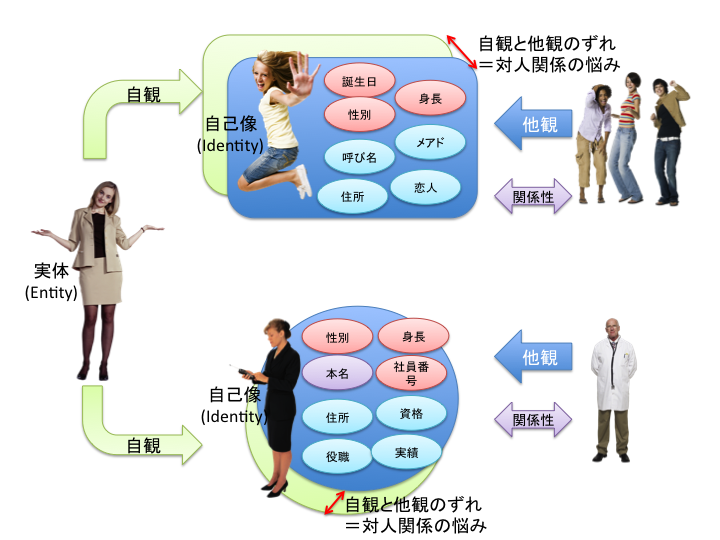
An Introduction to Digital Identity for Non-Technical Readers
“An Introduction for Non-Technical Readers to the Difference Between OAuth Authentication (?) and OpenID” surpassed 800 Hatena Bookmarks, which put me in a good mood, so…

Serious Oversight Problems in the U.S. Internal Revenue Service (IRS) Identity Verification System Revealed by a Government Accountability Office Report
Introduction Most people in the United States use IRS (Internal Revenue Service) services online because they handle tax-related procedures online. In doing so, many taxpayers must…
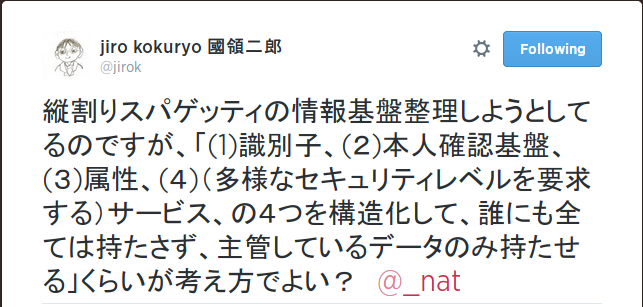
Trying to Untangle a Vertically Siloed Spaghetti Information Infrastructure, but…
Professor Kokuryo, whom I deeply respect, gave me this topic. It took a little time, but I have now put my thoughts together in this blog…